
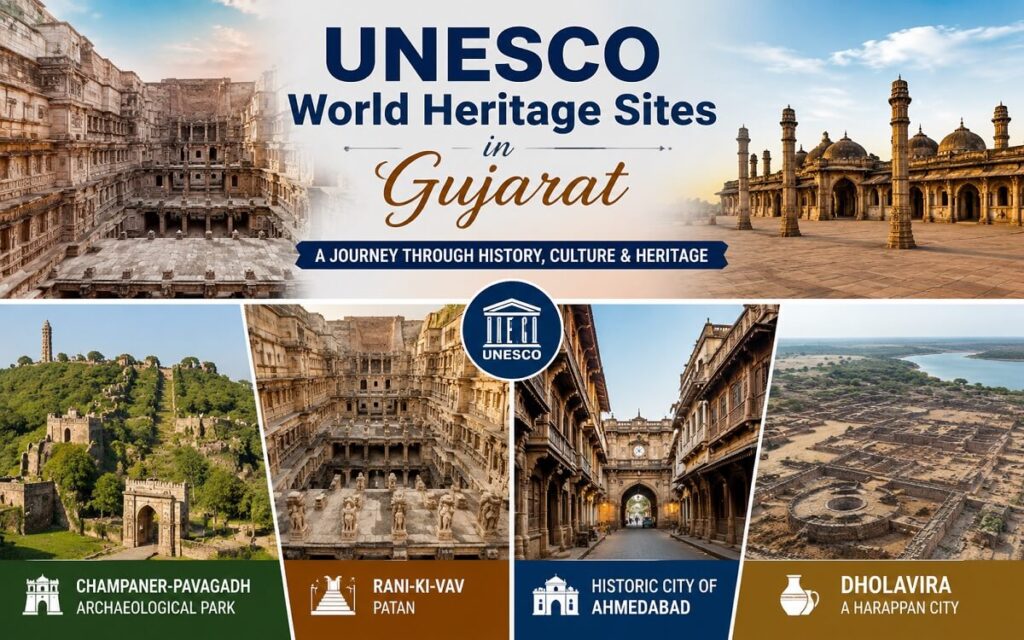
Gujarat is often associated with the white salt desert of Kutch, Asiatic lions in Gir National Park, the sacred temples of Dwarka and Somnath, and its colorful textile traditions. Yet some of the state’s most fascinating attractions tell a much older story.
Across Gujarat, travelers can walk through a living medieval city, descend into an intricately carved stepwell, explore the ruins of a former Islamic capital beneath a sacred hill, and stand among the remains of a city created by the Harappan civilization thousands of years ago.
These places are not simply important tourist attractions. They form Gujarat’s collection of UNESCO World Heritage properties and together reveal several remarkable chapters of Indian history.
As of 2026, Gujarat has four cultural properties on UNESCO’s World Heritage List:
- Champaner-Pavagadh Archaeological Park
- Rani-ki-Vav, the Queen’s Stepwell at Patan
- Historic City of Ahmadabad
- Dholavira: a Harappan City
UNESCO’s current list for India confirms all four as cultural World Heritage properties.
What makes them particularly interesting is their diversity. Dholavira takes visitors back to the third millennium BCE, while Rani-ki-Vav represents sophisticated 11th-century architecture. Champaner reveals medieval urban planning and religious traditions, and Ahmedabad preserves a historic urban community that remains very much alive today.
For anyone interested in archaeology, architecture, photography, culture, or Indian history, exploring the UNESCO World Heritage Sites in Gujarat can easily become the foundation of an unforgettable journey through western India.
Travelers planning a longer trip can also explore Tusk Travel’s Gujarat tour packages, which cover destinations such as Ahmedabad, Kutch, Gir, Somnath, Dwarka, Patan and other important parts of the state.
UNESCO World Heritage Sites in Gujarat at a Glance
| UNESCO Site | Location | UNESCO Inscription | Best Known For |
| Champaner-Pavagadh Archaeological Park | Panchmahal | 2004 | Medieval capital, mosques, forts, temples and water systems |
| Rani-ki-Vav | Patan | 2014 | Intricately carved seven-level stepwell |
| Historic City of Ahmadabad | Ahmedabad | 2017 | Pol houses, old-city streets and Sultanate architecture |
| Dholavira: a Harappan City | Kutch | 2021 | Indus Valley urban planning and water management |
These four destinations span thousands of years, making Gujarat one of the most rewarding states in India for travelers interested in cultural heritage.
List of UNESCO World Heritage Sites in Gujarat:
1. Champaner-Pavagadh Archaeological Park
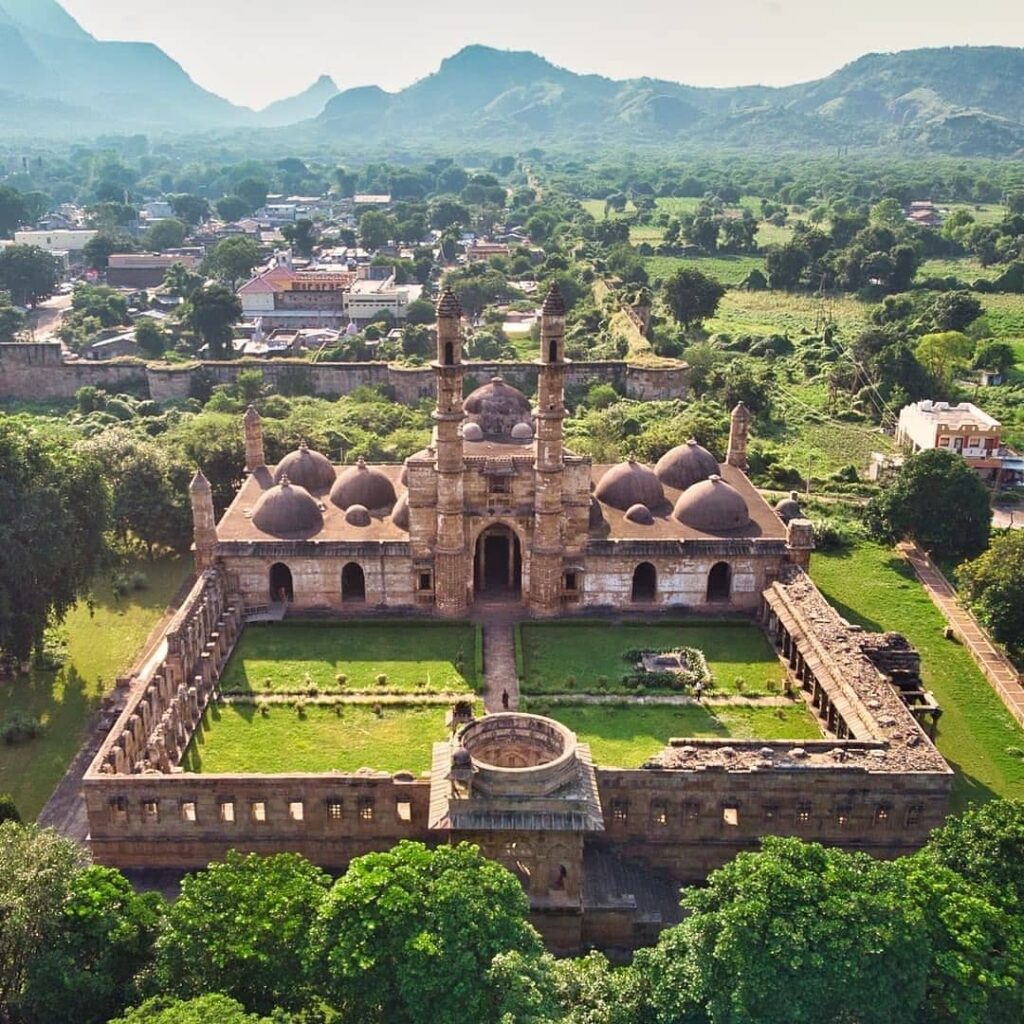
Champaner-Pavagadh Archaeological Park is one of Gujarat’s most extraordinary historical destinations, yet international travelers sometimes overlook it in favor of better-known monuments elsewhere in India.
Located in Panchmahal district, the UNESCO property combines archaeological remains, religious monuments, fortifications, settlements, water structures and the dramatic landscape surrounding Pavagadh Hill.
UNESCO inscribed Champaner-Pavagadh Archaeological Park in 2004. It describes the site as containing archaeological, historical and living cultural heritage ranging from prehistoric settlements to an early Hindu hill fortress and the remains of Gujarat’s former capital.
Why Champaner-Pavagadh is unique
Few destinations allow travelers to experience so many layers of history in a single landscape.
The area contains evidence from prehistoric times, remains associated with Hindu rulers and significant architecture from the Gujarat Sultanate. Rather than being a single monument, Champaner-Pavagadh is a vast cultural landscape.
One of its most important historical phases began when Sultan Mahmud Begada captured Pavagadh in 1484 and developed Champaner as his capital. The city later lost its political importance, leaving behind an unusually preserved archaeological landscape.
UNESCO considers Champaner especially significant because it preserves an exceptionally complete example of a pre-Mughal Islamic city.
Jami Masjid
Among the finest monuments at Champaner is the Jami Masjid, sometimes called Jama Masjid.
Built during the Gujarat Sultanate period, the mosque combines Islamic architectural planning with craftsmanship influenced by local Hindu and Jain building traditions.
Look closely at its carved pillars, screens, domes and decorative details. This blending of architectural traditions became one of the characteristics of medieval Gujarat.
UNESCO specifically notes the Great Mosque as an important example of this architectural synthesis and a structure that influenced later mosque architecture in India.
Kalika Mata Temple
At the top of Pavagadh Hill stands the Kalika Mata Temple, an important pilgrimage destination.
Unlike many archaeological sites that survive mainly as ruins, Champaner-Pavagadh remains connected with active religious traditions. Pilgrims continue to travel to the temple throughout the year.
This combination of archaeological remains and living cultural practices adds considerably to the atmosphere of the destination.
Fortifications and ruined settlements
Travel slowly through Champaner and you will encounter:
- ancient gateways
- ruined palaces
- mosques
- tombs
- defensive walls
- reservoirs
- stepwells
- residential remains
- religious structures
Some areas remain unexcavated, making the landscape feel more like an archaeological discovery than a conventional monument complex.
How much time do you need?
Allow at least four to six hours if you want to appreciate Champaner properly.
Travelers particularly interested in archaeology or photography can spend most of the day exploring different monuments before heading toward Pavagadh.
Champaner can conveniently be combined with Vadodara, while travelers using Ahmedabad as their main base can also include it in a longer Gujarat circuit.
2. Rani-ki-Vav, the Queen’s Stepwell at Patan
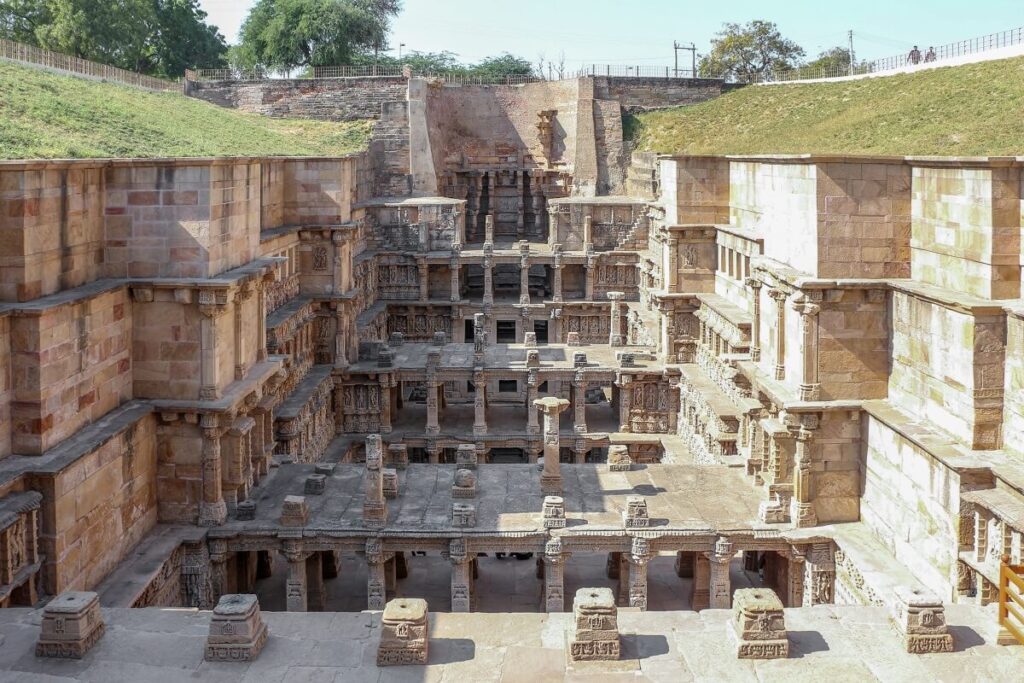
If there is one monument in Gujarat that consistently surprises first-time visitors, it is Rani-ki-Vav.
From ground level, the structure gives little indication of what lies beneath. As visitors descend, however, successive levels reveal columns, pavilions and hundreds of detailed sculptures.
Located in Patan, Rani-ki-Vav was inscribed on UNESCO’s World Heritage List in 2014.
UNESCO describes it as an exceptional example of subterranean water architecture. Built during the 11th century, the stepwell was conceived as both a functional water structure and an inverted temple emphasizing the sacred nature of water.
The story behind Rani-ki-Vav
Rani-ki-Vav translates roughly as “the Queen’s Stepwell.”
It is traditionally associated with Queen Udayamati and was constructed in memory of King Bhima I of the Solanki dynasty.
Stepwells once played an important role in western India. In regions where water supplies changed dramatically between seasons, these structures allowed communities to reach groundwater by descending through a series of steps.
But Rani-ki-Vav went far beyond practical engineering.
It transformed water architecture into monumental art.
Seven levels of architecture
The stepwell descends through seven levels, gradually leading toward the well shaft.
The scale becomes clearer as you walk down through its carved corridors. Pillars and sculptural panels create the feeling of entering a subterranean temple rather than simply approaching a water source.
UNESCO notes that Rani-ki-Vav contains more than 500 principal sculptures and over a thousand smaller figures, incorporating religious, mythological and secular themes.
What to look for
Do not rush toward the bottom.
Spend time observing the carvings along the walls and pillars. Many depict deities, celestial figures and scenes associated with Hindu traditions.
Representations of Vishnu are particularly prominent, including several of his avatars.
The detail can be extraordinary, especially considering that these carvings were created centuries before modern tools.
Why was Rani-ki-Vav preserved so well?
One reason the monument survived is rather unusual.
Over time, the stepwell became filled with sediment. Although this concealed it for centuries, the accumulated material also helped protect much of its carved decoration.
After archaeological excavation and conservation, the extraordinary scale of the monument became visible again.
Today, it is one of India’s finest surviving stepwells.
Rani-ki-Vav for photographers
Morning light generally provides excellent conditions for photography.
The changing depth of the structure creates dramatic layers of light and shadow, while the repeating pillars provide strong architectural compositions.
A wide-angle lens is useful for capturing the scale of the stepwell, while a moderate zoom helps photograph individual sculptures.
What else can you visit around Patan?
Patan deserves more than a hurried stop.
Travelers interested in traditional crafts should learn about Patan Patola, the city’s famous double-ikat weaving tradition.
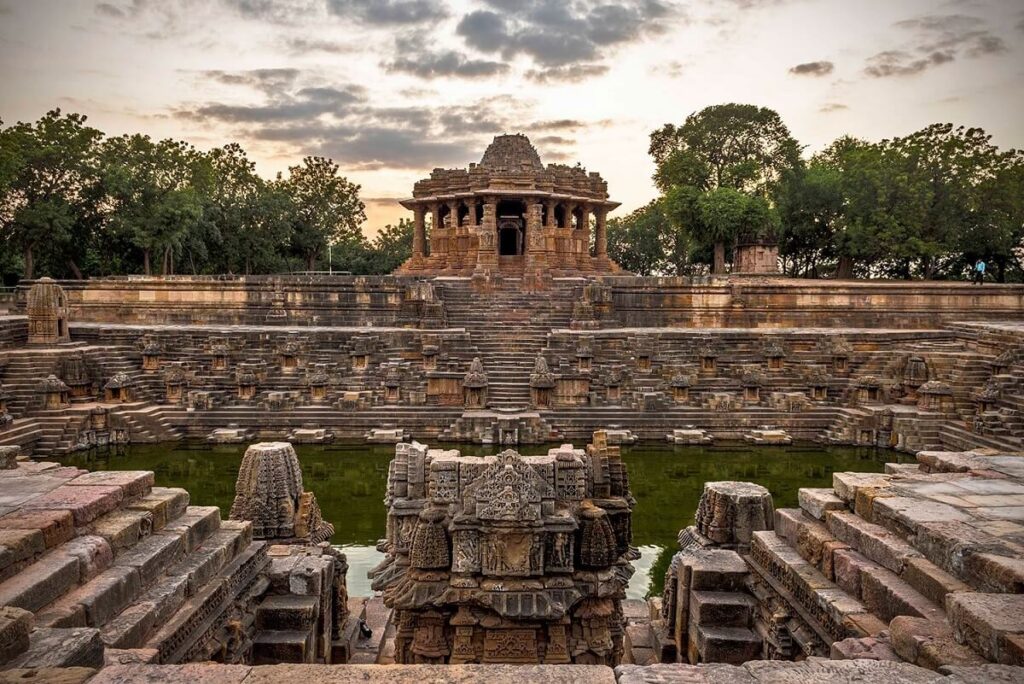
You can also combine Patan with the Sun Temple at Modhera, one of Gujarat’s outstanding temple complexes.
Although Modhera is not currently one of Gujarat’s inscribed UNESCO World Heritage properties, it is an excellent addition to a heritage-focused journey.
A popular day route is:
Ahmedabad → Modhera → Patan → Ahmedabad
For a slower trip, stay overnight nearby and spend additional time exploring the region.
Tusk Travel’s guide to World Heritage Sites in Western India also discusses Rani-ki-Vav alongside other significant heritage destinations in western India.
3. Historic City of Ahmadabad
Ahmedabad offers a completely different UNESCO experience.
Here, heritage is not confined inside an archaeological park. People live, shop, pray and work within the historic urban landscape.
UNESCO inscribed the Historic City of Ahmadabad in 2017. The property covers the historic walled city founded by Sultan Ahmad Shah in 1411 on the eastern bank of the Sabarmati River.
Ahmedabad became especially significant because it demonstrated how architecture, religion, commerce and community organization developed together over centuries.
Exploring Ahmedabad’s old city
The best way to understand Ahmedabad’s UNESCO heritage is on foot.
Inside the old city you will find narrow lanes, historic gates, religious buildings, markets, traditional houses and tightly organized neighborhoods known as pols.
Pols are one of the defining characteristics of historic Ahmedabad.
They are clusters of traditional residences connected by narrow streets and gateways. Historically, these communities developed their own systems of social organization, security and shared facilities.
Some contain elaborate timber houses with beautifully carved façades.
UNESCO highlights the old city’s wooden domestic architecture and its community-based settlement structure as particularly important aspects of Ahmedabad’s heritage.
Bhadra Fort
Bhadra Fort formed an important part of the original city established by Sultan Ahmad Shah.
The surrounding area reveals the political and commercial center around which medieval Ahmedabad developed.
Although the modern city has expanded enormously, exploring the historic quarter gives travelers a sense of how its original urban structure evolved.
Jama Masjid
Ahmedabad’s Jama Masjid is another important stop.
Its broad courtyard, carved stone pillars and architectural details illustrate the distinctive style that developed under the Gujarat Sultanate.
Visitors interested in architecture may notice similarities between the craftsmanship found here and at Champaner.
Together, the two destinations help explain the evolution of regional architecture in Gujarat.
Traditional pol houses
The real magic of Ahmedabad often appears away from its major monuments.
Walk through the old neighborhoods early in the morning and you may see:
- intricately carved wooden façades
- internal courtyards
- tiny shrines
- neighborhood gates
- bird-feeding towers known as chabutras
- markets beginning their daily routines
- small Jain and Hindu temples hidden within residential streets
Rather than treating Ahmedabad as a checklist of monuments, spend time observing how these spaces function.
That is where the UNESCO designation begins to make sense.
Sidi Saiyyed Mosque
Although the UNESCO property is the wider historic city rather than any single monument, travelers should also visit the Sidi Saiyyed Mosque.
Its famous stone latticework, particularly the tree-inspired jali design, has become one of Ahmedabad’s visual symbols.
Sabarmati Ashram
Sabarmati Ashram is not itself the reason Ahmedabad received UNESCO World Heritage status, but it is essential to understanding the modern history of the city.
Mahatma Gandhi lived and worked here during a crucial period of India’s independence movement.
Because of this, Ahmedabad offers travelers an unusual range of historical perspectives, from Sultanate architecture to traditional merchant neighborhoods and India’s freedom struggle.
Best way to experience Ahmedabad
Spend at least two nights in Ahmedabad.
On your first morning, take an old-city heritage walk. Later, explore museums, Sabarmati Ashram and some of the city’s food and textile traditions.
Ahmedabad also makes an excellent starting point for a broader Gujarat itinerary.
The Tusk Travel Gujarat travel and tour page includes Ahmedabad in several routes alongside Kutch, Gir, Dwarka, Somnath, Patan and other parts of Gujarat.
Gujarat Packages:
- 5 Days Ahmedabad, Sasangir & Diu Itinerary
- 8 Nights 9 Days Gujarat Package
- 3 Days Ahmedabad & Vadodara Tour
- 11 Days Textile Tour of Gujarat
4. Dholavira: A Harappan City
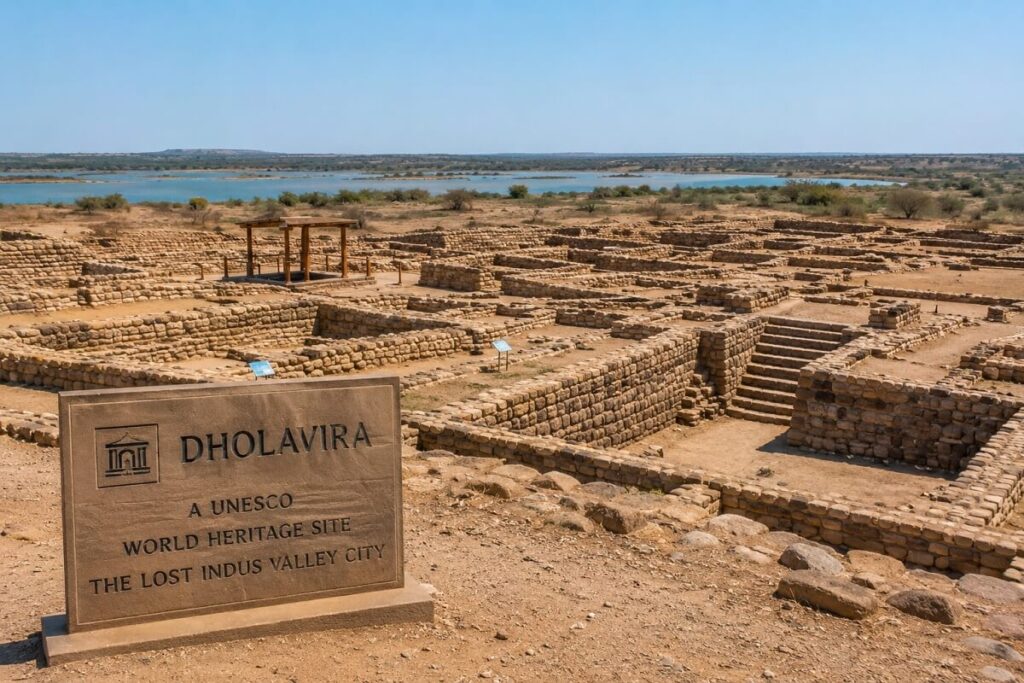
Of all the UNESCO World Heritage Sites in Gujarat, Dholavira takes travelers furthest back in time.
Located on Khadir Island in the Kutch region, Dholavira was a major urban settlement belonging to the Harappan or Indus Valley Civilization.
UNESCO inscribed Dholavira: a Harappan City in 2021.
The archaeological remains date broadly from the third to the middle of the second millennium BCE, and UNESCO identifies Dholavira as one of the few exceptionally well-preserved urban settlements from this civilization.
Why Dholavira matters
Many travelers learn about the Indus Valley Civilization through textbooks, but standing at Dholavira makes its sophistication much easier to comprehend.
This was not simply a loose group of homes.
It was a carefully organized urban center containing fortified areas, streets, reservoirs and separate functional zones.
UNESCO identifies Dholavira as one of the largest known Harappan sites and notes that it was occupied for more than 1,500 years.
Sophisticated water management
Water management is one of Dholavira’s most remarkable features.
The surrounding region is dry and environmentally challenging, yet the city’s inhabitants created an elaborate network designed to capture, channel and store water.
Large reservoirs formed an essential part of the settlement.
For modern visitors, these structures provide a powerful reminder that advanced environmental engineering is not a recent invention.
The Harappans had developed sophisticated solutions thousands of years ago.
Urban planning
Archaeological evidence reveals a structured settlement with fortified sections.
UNESCO describes the property as consisting of a walled city and a cemetery. Within the city were a fortified castle, bailey, ceremonial ground, Middle Town and Lower Town, with reservoirs positioned near the citadel.
Understanding this organization is much easier with a knowledgeable guide.
Without context, some archaeological remains may initially look like simple stone foundations. Once their purpose is explained, the scale of Dholavira becomes far more impressive.
Trade beyond Gujarat
Dholavira was also connected with wider commercial networks.
Archaeological discoveries indicate links with other Harappan settlements as well as long-distance trade networks reaching toward Mesopotamia and the Oman Peninsula.
This challenges the idea that ancient settlements were isolated.
Thousands of years ago, communities in this part of Gujarat participated in surprisingly extensive systems of exchange.
The landscape around Dholavira
Part of the attraction is the journey itself.
Dholavira lies in the striking landscape of Kutch, where dry terrain, seasonal wetlands and enormous horizons create a completely different atmosphere from Ahmedabad or Patan.
The archaeological site feels remote, and that isolation contributes enormously to the experience.
Visitors can easily imagine why controlling water and adapting to environmental conditions would have been so important here.
How long should you allow?
Do not treat Dholavira as a quick side trip.
Its location means it works best as part of a wider Kutch itinerary.
Allow at least one full day around Dholavira, with additional travel time depending on where you are staying.
Travelers exploring the broader region may combine it with Bhuj, local craft villages and the Great Rann of Kutch.
Which UNESCO World Heritage Site in Gujarat Should You Visit First?
If possible, visit all four. They represent completely different periods and styles of heritage.
But if time is limited, your interests can help determine which one to prioritize.
Choose Ahmedabad if you enjoy living heritage
Ahmedabad is best for travelers interested in old neighborhoods, markets, architecture, food and everyday urban culture.
It is also the easiest UNESCO site to incorporate into most Gujarat itineraries.
Choose Rani-ki-Vav if you love architecture and sculpture
Rani-ki-Vav is perhaps the most immediately visually impressive of Gujarat’s UNESCO monuments.
It is easy to combine with Modhera and works particularly well for photographers.
Choose Champaner-Pavagadh for archaeology and religious history
Champaner suits travelers who enjoy exploring large historical landscapes rather than single monuments.
Its combination of mosques, ruins, fortifications, hill scenery and pilgrimage traditions makes it distinctive.
Choose Dholavira for ancient history
If the Indus Valley Civilization fascinates you, Dholavira should be a priority.
Its remote setting requires more planning, but it provides the oldest historical perspective among Gujarat’s UNESCO sites.
Best Itinerary for 7 Days Gujarat’s UNESCO World Heritage Sites:
Travelers specifically interested in heritage can build an excellent journey around all four UNESCO properties.
Day 1: Arrive in Ahmedabad
Arrive in Ahmedabad and settle into your hotel.
If time permits, visit Sabarmati Ashram and enjoy a traditional Gujarati dinner.
Day 2: Historic Ahmedabad
Start early with a guided walk through the UNESCO-listed historic city.
Explore traditional pol neighborhoods, Jama Masjid, old gateways and important heritage buildings.
Spend the afternoon visiting museums, markets or additional architectural landmarks.
Day 3: Ahmedabad – Modhera – Patan
Drive toward Patan, stopping at Modhera Sun Temple.
Continue to Rani-ki-Vav and spend enough time studying its sculptures and architectural levels.
Stay near Patan or continue depending on your wider itinerary.
Day 4: Ahmedabad/Vadodara – Champaner-Pavagadh
Travel toward Champaner-Pavagadh Archaeological Park.
Explore Jami Masjid, ruined structures and archaeological remains before visiting Pavagadh according to your interests and available time.
Overnight around Vadodara.
Day 5: Travel toward Kutch
Begin the longer journey toward the Kutch region.
Depending on routing, you may break the journey or continue toward Bhuj.
Day 6: Kutch – Dholavira
Travel to Dholavira and explore the Harappan archaeological site with a guide.
Examine the fortified sections, reservoirs and surviving urban layout.
Day 7: Dholavira and Kutch
Spend additional time around Khadir Island before continuing into the Rann of Kutch region or returning toward Bhuj.
Travelers with more time should extend the itinerary to 9 to 12 days, combining UNESCO heritage with Bhuj, craft villages and the White Rann.
For broader itinerary ideas, browse the Tusk Travel blog and Gujarat travel guides covering the state’s history, culture and destinations.
Best Time to Visit UNESCO Sites in Gujarat:
The most comfortable period for a heritage trip through Gujarat is generally October to March.
Tusk Travel’s Gujarat guide also identifies October through March as the prime travel period for heritage walks, craft villages, safaris and Kutch experiences.
October to November
Temperatures begin becoming more pleasant after the monsoon.
This is a good period for architecture, photography and outdoor exploration.
December to February
These are usually the most comfortable months for a comprehensive Gujarat trip.
Early mornings can be cool, particularly around Kutch, while daytime conditions are generally favorable for walking.
This period is especially convenient for combining UNESCO sites with the Rann of Kutch.
March
March can still be suitable, although afternoons become warmer.
Start sightseeing earlier in the day.
April to June
Summer temperatures can become intense.
If visiting during these months, schedule archaeological sites for early morning and avoid spending long periods outdoors during the hottest afternoon hours.
July to September
Monsoon brings greener landscapes to parts of Gujarat, particularly around Champaner and Pavagadh.
However, rain and humidity can influence road conditions and sightseeing schedules.
Tips for Visiting Gujarat’s UNESCO Heritage Sites:
Hire knowledgeable local guides
A good guide can transform an archaeological site.
This is especially true at Dholavira and Champaner, where understanding the original function of walls, reservoirs and ruined structures adds enormously to the experience.
Start early
Heritage sites are more comfortable and photogenic during the morning.
Early starts also help avoid the strongest afternoon temperatures.
Dress respectfully
Some UNESCO areas contain active religious places.
Wear clothing that covers shoulders and knees when entering temples or mosques and follow local rules regarding footwear and photography.
Carry water
Gujarat can remain warm even during the winter season.
Keep drinking water available, especially when walking around archaeological complexes.
Wear comfortable footwear
Rani-ki-Vav involves stairs, Ahmedabad requires walking through narrow streets, and Champaner and Dholavira involve uneven archaeological terrain.
Comfortable footwear is essential.
Avoid rushing
Four UNESCO properties do not mean four quick photo stops.
Each site represents a completely different period of history.
Spending sufficient time at each destination creates a far more meaningful journey.
Other Heritage Places to Combine with Gujarat’s UNESCO Sites:
A UNESCO-focused itinerary can easily be expanded with several outstanding attractions.
Modhera Sun Temple
Located conveniently between Ahmedabad and Patan, Modhera is famous for its temple architecture and ceremonial water tank.
It combines naturally with Rani-ki-Vav.
Adalaj Stepwell
Travelers fascinated by Rani-ki-Vav should also visit Adalaj.
Although smaller and from a later period, it provides another excellent example of Gujarat’s stepwell tradition.
Bhuj
Bhuj is an ideal base for exploring Kutch’s crafts, architecture and nearby villages.
It can be combined with Dholavira during a longer regional itinerary.
Great Rann of Kutch
Few landscapes contrast more dramatically with Gujarat’s historic monuments than the White Rann.
Its vast salt flats are especially atmospheric around sunset.
Dwarka and Somnath
Travelers interested in religious heritage can extend their itinerary to Gujarat’s western coast and visit two of India’s most important pilgrimage destinations.
Gir National Park
For a complete Gujarat journey, add wildlife to the cultural itinerary.
Gir is famous as the principal habitat of the Asiatic lion and creates a very different experience after several days of heritage sightseeing.
Tusk Travel’s Gujarat itineraries already combine destinations such as Ahmedabad, Kutch, Gir, Somnath and Dwarka, making it possible to incorporate UNESCO heritage into a broader private journey through the state.
Why Gujarat Is One of India’s Best Heritage Destinations:
The real strength of Gujarat is not simply the number of UNESCO sites it contains.
It is the enormous historical range represented by them.
At Dholavira, you can examine urban planning developed more than four thousand years ago.
At Rani-ki-Vav, you see how water engineering became sacred architecture and sculptural art.
At Champaner-Pavagadh, layers of Hindu, Islamic and living religious traditions occupy the same cultural landscape.
And in Ahmedabad, heritage continues inside neighborhoods where centuries-old urban patterns still shape daily life.
Few journeys can move so naturally from the Indus Valley Civilization to medieval stepwells, Sultanate cities and modern urban culture.
That diversity is exactly what makes a Gujarat heritage tour so rewarding.
Frequently Asked Questions About UNESCO World Heritage Sites in Gujarat
1. How many UNESCO World Heritage Sites are there in Gujarat?
As of 2026, Gujarat has four UNESCO World Heritage properties: Champaner-Pavagadh Archaeological Park, Rani-ki-Vav at Patan, the Historic City of Ahmadabad, and Dholavira: a Harappan City. All four are classified as cultural properties.
2. Which was the first UNESCO World Heritage Site in Gujarat?
Champaner-Pavagadh Archaeological Park was the first of Gujarat’s current UNESCO properties to be inscribed, receiving World Heritage status in 2004.
3. Which is the newest UNESCO World Heritage Site in Gujarat?
Among Gujarat’s four currently inscribed properties, Dholavira: a Harappan City is the newest. It was added to the World Heritage List in 2021.
4. Is Ahmedabad a UNESCO World Heritage City?
Yes. The Historic City of Ahmadabad was inscribed on UNESCO’s World Heritage List in 2017. Its significance includes its historic walled-city structure, Sultanate monuments, traditional wooden houses and pol neighborhoods.
5. Is the Statue of Unity a UNESCO World Heritage Site?
No. The Statue of Unity is an important modern tourist attraction in Gujarat, but it is not currently a UNESCO World Heritage Site.
6. Is the Rann of Kutch a UNESCO World Heritage Site?
No. The Great Rann of Kutch is one of Gujarat’s most famous natural landscapes, but it is not currently inscribed on UNESCO’s World Heritage List. Dholavira, which lies within the wider Kutch region, is UNESCO-listed.
7. How many days are needed to visit Gujarat’s four UNESCO sites?
A focused trip can cover the four sites in about six to seven days, although eight to ten days provides a more comfortable pace and allows you to include Modhera, Vadodara, Bhuj and the Rann of Kutch.
Final Thoughts
The UNESCO World Heritage Sites of Gujarat provide something far more interesting than a collection of beautiful monuments. Together, they form a timeline stretching across thousands of years.
Dholavira reveals the engineering and urban intelligence of the Harappans. Rani-ki-Vav demonstrates the extraordinary craftsmanship of medieval Gujarat. Champaner-Pavagadh preserves the remains of a former capital alongside an active pilgrimage landscape. Ahmedabad shows how historic architecture and community life can continue inside a modern city.
For first-time visitors, Ahmedabad and Rani-ki-Vav are the easiest to incorporate into a standard Gujarat journey. Travelers with more time should add Champaner and continue deep into Kutch for Dholavira.
Combine these places with the White Rann, traditional craft villages, Gir National Park, Dwarka or Somnath, and Gujarat becomes much more than a heritage trip. It becomes a journey through ancient cities, sacred architecture, living traditions, wildlife and some of western India’s most unusual landscapes.
Travelers planning a private itinerary can explore Gujarat tour packages from Tusk Travel for routes covering Ahmedabad, Kutch, Gir, Somnath, Dwarka, Patan and other major destinations across the state.
Also read, another UNESCO:
