
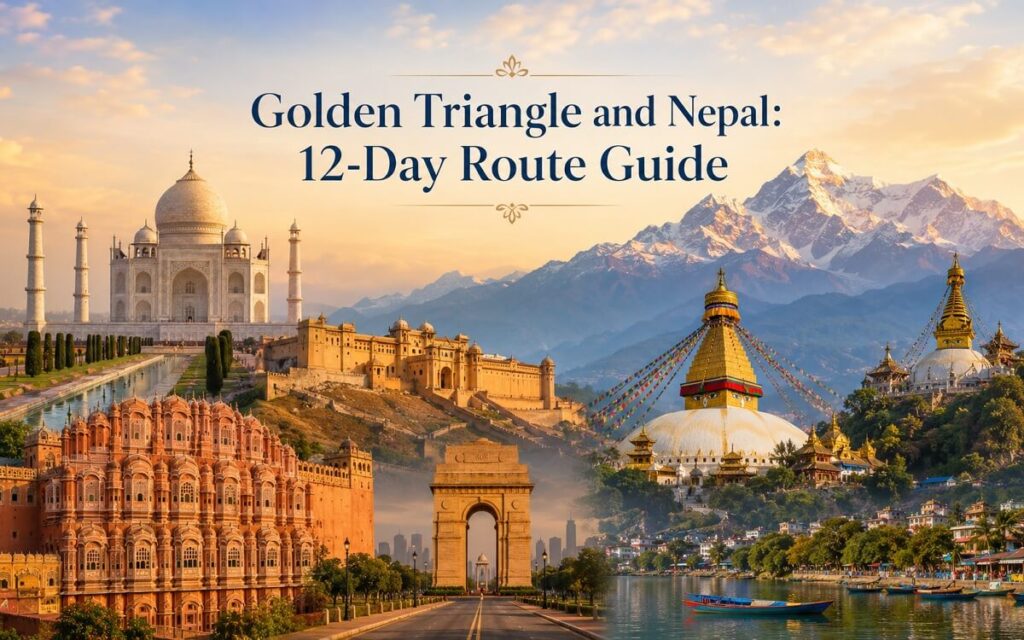
Planning a 12-day Golden Triangle and Nepal trip is one of the most rewarding ways to experience two of South Asia’s most fascinating destinations in a single holiday. In less than two weeks, you can explore the energetic streets and historic monuments of Delhi, stand before the Taj Mahal in Agra, discover the palaces and forts of Jaipur, and then fly north to Nepal for ancient temples, Himalayan landscapes, and the relaxed atmosphere of Kathmandu and Pokhara.
For first-time visitors, the combination works particularly well because India and Nepal offer very different experiences without requiring complicated long-distance travel between them. India’s famous Golden Triangle connects Delhi, Agra, and Jaipur, while direct flights from Delhi make Kathmandu an easy next stop. Tusk Travel’s Golden Triangle itineraries also use Delhi, Agra and Jaipur as the core route, making it a practical introduction to northern India.
The challenge is fitting everything into 12 days without turning the trip into a race. Adding too many destinations can mean spending more time checking into hotels and travelling than actually enjoying the places you came to see.
A well-balanced route is therefore:
Delhi → Jaipur → Agra → Delhi → Kathmandu → Pokhara → Kathmandu
This guide explains how to organize that route, how many nights to spend in each place, what to see, when to travel, how to connect India with Nepal, and what practical details you should arrange before departure.
If you are still comparing routes, you can also explore Tusk Travel’s Golden Triangle tour packages and Nepal tour packages before finalizing your itinerary.
Why Combine the Golden Triangle and Nepal?
India’s Golden Triangle is popular because Delhi, Agra and Jaipur provide three very different introductions to the country within a relatively compact geographical area.
Delhi combines medieval monuments, colonial architecture, religious landmarks, government districts and enormous markets. Agra introduces travellers to the grandeur of the Mughal period through the Taj Mahal and Agra Fort. Jaipur brings Rajput history, hilltop forts, colourful bazaars and elaborate palaces into the journey.
Nepal provides a natural second chapter.
Instead of more large cities and Mughal or Rajput architecture, you enter a Himalayan country where Buddhist stupas, Hindu temples, medieval squares, mountains and lakes create a completely different atmosphere.
Kathmandu is especially rich in cultural heritage, with important Hindu and Buddhist sites as well as historic neighbourhoods. Tusk Travel’s Kathmandu guide highlights places such as ancient temples, UNESCO heritage areas and traditional city districts as major reasons to visit.
Adding Pokhara gives the trip another change of pace. After several busy sightseeing days in India and Kathmandu, the lakeside city offers mountain views, boating and quieter evenings.
That contrast is exactly what makes an India Golden Triangle and Nepal itinerary more memorable than trying to squeeze several similar destinations into the same holiday.
Ideal 12-Day Golden Triangle and Nepal Itinerary:
A practical itinerary should give you enough sightseeing time while keeping long transfers under control.
Here is a balanced route.
Day 1: Arrive in Delhi
Your Golden Triangle and Nepal adventure begins in Delhi.
After an international flight, avoid planning a full sightseeing programme immediately. Airport formalities, baggage collection, traffic and jet lag can make even a short arrival day tiring.
Transfer to your hotel and use the remainder of the day to rest.
If you arrive early enough and still have energy, take a gentle walk around your hotel neighbourhood or enjoy an early dinner.
Delhi is a huge city, so staying in a convenient central location can save considerable travelling time the following day.
For more destination ideas, see Tusk Travel’s Delhi tours and travel guide.
Overnight: Delhi
Day 2: Explore Old and New Delhi
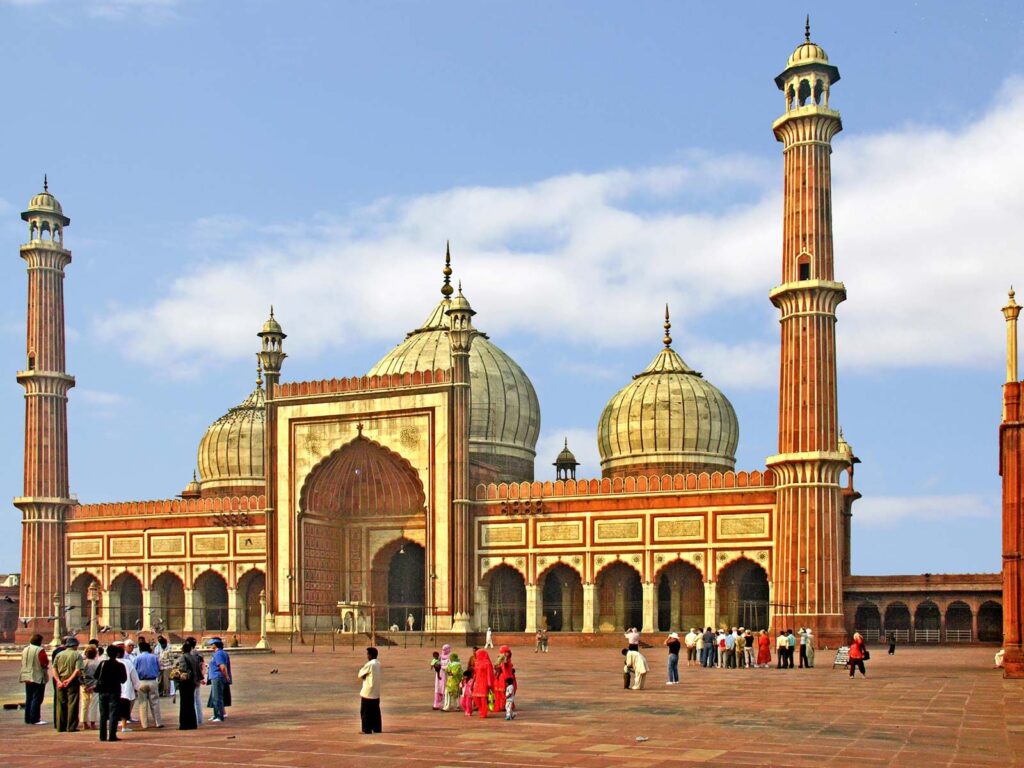
Begin your first full day with Old Delhi.
Depending on your interests and opening schedules, your sightseeing may include Jama Masjid, Chandni Chowk and the historic lanes surrounding the old city.
A cycle-rickshaw ride through Chandni Chowk is one of the most atmospheric introductions to Delhi. You move through narrow streets filled with shops, spice merchants, food stalls, jewellery stores and centuries-old religious buildings.
Later, continue toward New Delhi.
Major landmarks can include:
- Raj Ghat
- Humayun’s Tomb
- Qutub Minar
- India Gate area
- government avenues
- Gurudwara Bangla Sahib
Do not attempt to see every famous Delhi monument in one day. Selecting several important sights and leaving time for lunch, photographs and traffic will produce a much better experience.
Delhi itself contains centuries of history, including major Mughal monuments, UNESCO sites and busy traditional markets.
Overnight: Delhi
Day 3: Delhi to Jaipur
After breakfast, drive from Delhi to Jaipur.
The journey normally occupies a large part of the morning and early afternoon, so this should not be treated as another full sightseeing day.
Once you reach Jaipur, check into your hotel and relax before exploring the old city later in the afternoon.
One of the best introductions to Jaipur is simply walking through the bazaars around the historic Pink City.
You may browse textiles, jewellery, handicrafts, block-printed fabrics, blue pottery and traditional souvenirs.
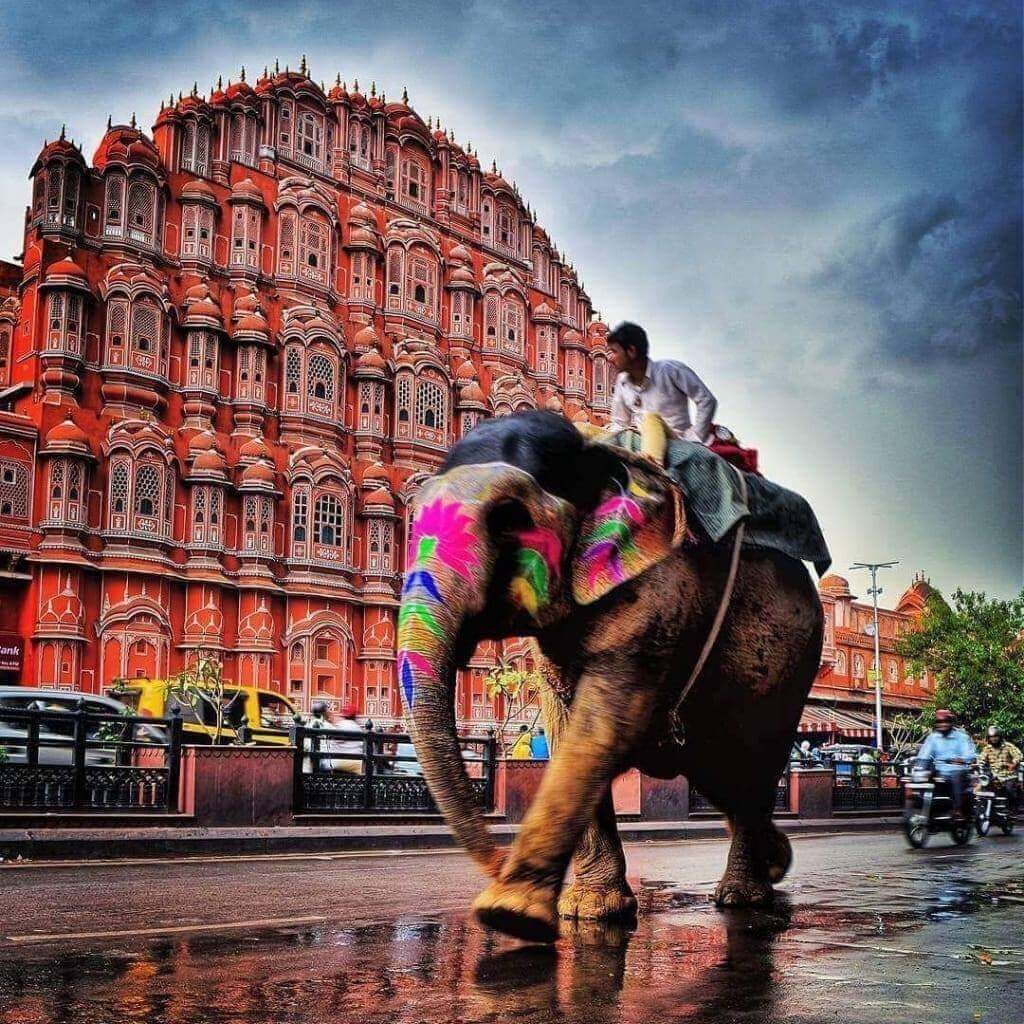
If time permits, stop near the Hawa Mahal for photographs in the late afternoon.
Jaipur can feel more relaxed than Delhi, although the old city remains colourful and busy.
Overnight: Jaipur
Day 4: Jaipur Sightseeing

Dedicate your entire fourth day to Jaipur.
Start early with Amber Fort, located outside the main city. The hilltop complex is one of Rajasthan’s most impressive landmarks, with courtyards, gateways, halls and views over the surrounding hills.
Continue to Jaipur’s historic centre.
Popular places include:
City Palace
The palace complex combines Rajput and Mughal architectural influences and remains closely connected with Jaipur’s royal heritage.
Jantar Mantar
Located near City Palace, this extraordinary astronomical observatory contains enormous instruments designed for observing celestial movements.
Hawa Mahal
The Palace of Winds is Jaipur’s most recognizable façade. Its hundreds of windows allowed royal women to observe street activity while remaining unseen.
You can also visit artisan workshops or explore local markets if shopping and traditional crafts interest you.
Tusk Travel’s Golden Triangle guide identifies Amber Fort, City Palace, Hawa Mahal and Jaipur’s artisan traditions among the city’s main highlights.
Avoid scheduling too much after dinner. You still have another important road journey the next morning.
Overnight: Jaipur
Day 5: Jaipur to Agra via Fatehpur Sikri
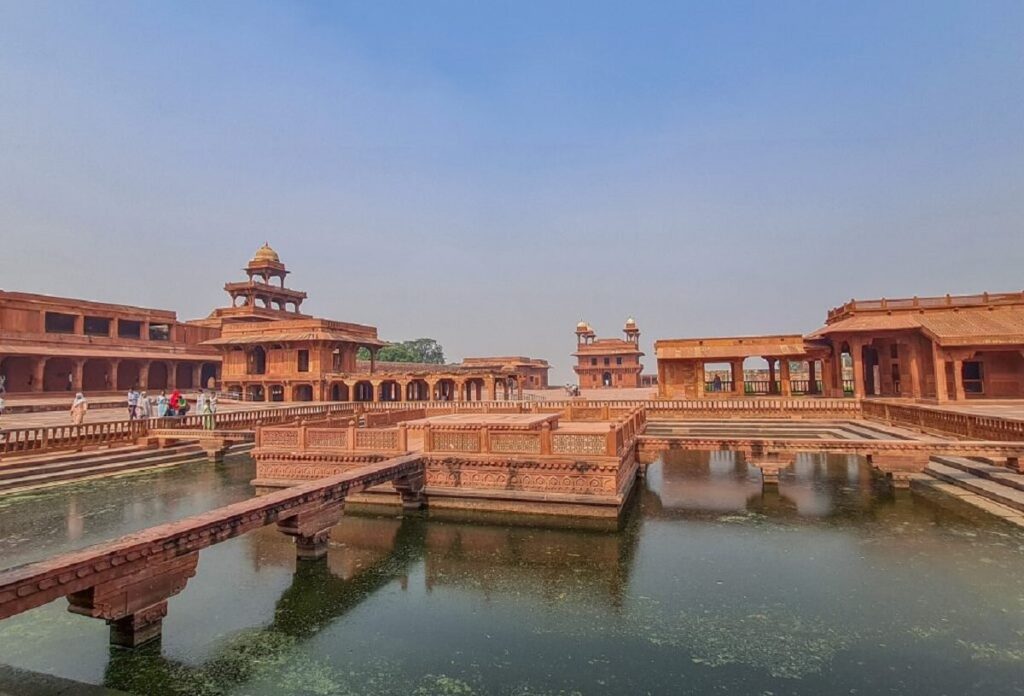
Leave Jaipur after breakfast and travel toward Agra.
Instead of treating this purely as a transfer day, stop at Fatehpur Sikri, the extraordinary former Mughal capital located outside Agra.
The complex contains palaces, courtyards, gateways and religious structures from the reign of Emperor Akbar.
After visiting Fatehpur Sikri, continue to Agra and check into your hotel.
Depending on arrival time, you could visit Mehtab Bagh for sunset views across the Yamuna River toward the Taj Mahal.
Do not worry if you cannot fit another monument into this evening. The main event is tomorrow morning.
Overnight: Agra
Day 6: Taj Mahal, Agra Fort and Return to Delhi
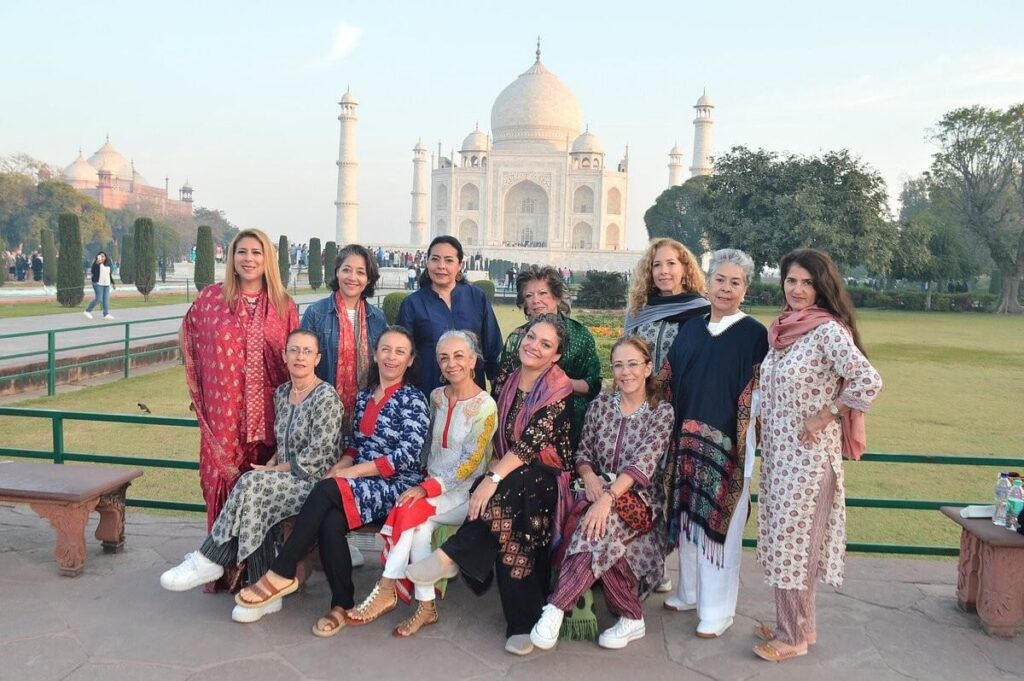
Wake early for one of the highlights of your entire journey: the Taj Mahal.
A sunrise visit is especially rewarding because temperatures can be cooler and the soft morning light transforms the colour of the marble.
Spend enough time inside the complex rather than rushing through simply to take photographs.
After breakfast, continue with Agra Fort.
The enormous red sandstone fortress served as an important Mughal residence and contains palaces, courtyards and viewpoints overlooking the Yamuna River.
Tusk Travel recommends around one to two days for Agra if you want to combine the Taj Mahal with Agra Fort and additional Mughal attractions.
You can explore more options through the Agra travel guide and tours.
Later, drive back to Delhi.
Try not to book your Nepal flight for the same evening. Traffic delays can occur, and a separate international flight deserves a buffer.
Overnight: Delhi
Day 7: Fly from Delhi to Kathmandu
Today you leave India and continue to Nepal.
Flying is by far the most practical option for a 12-day itinerary.
Direct services operate between Delhi’s Indira Gandhi International Airport and Kathmandu’s Tribhuvan International Airport, with flying time of roughly two hours depending on the flight. Current schedules show multiple nonstop services on the route.
Choose a morning or midday departure whenever possible.
Once you arrive in Kathmandu and complete immigration procedures, transfer to your hotel.
Do not schedule your most important Kathmandu sightseeing immediately after landing. International airport procedures and Kathmandu traffic can make arrival times unpredictable.
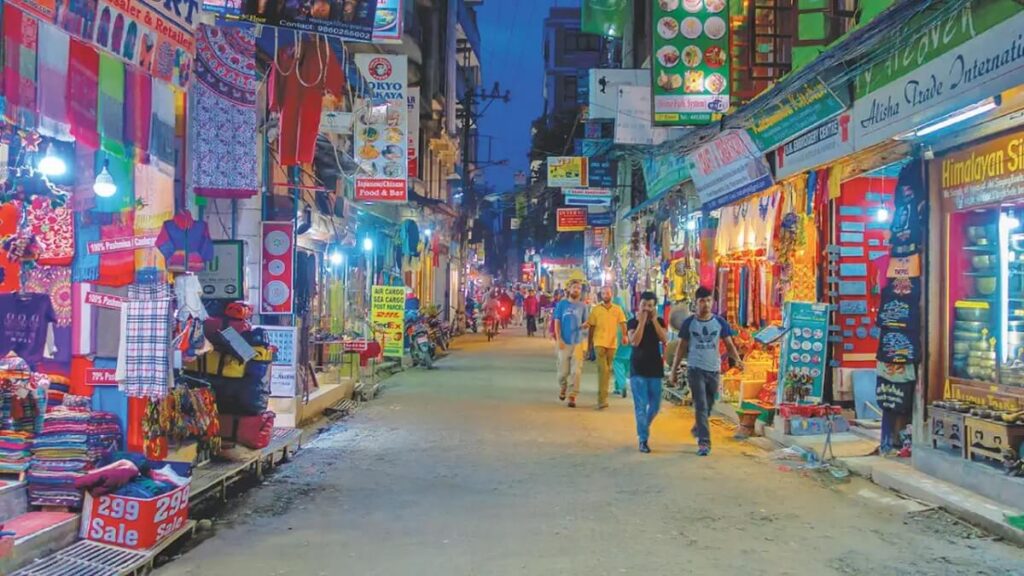
Instead, spend your first evening walking around Thamel, one of Kathmandu’s most popular visitor districts.
You will find cafés, restaurants, souvenir shops, outdoor equipment stores and small courtyards throughout the neighbourhood.
Overnight: Kathmandu
Day 8: Kathmandu Heritage Sightseeing
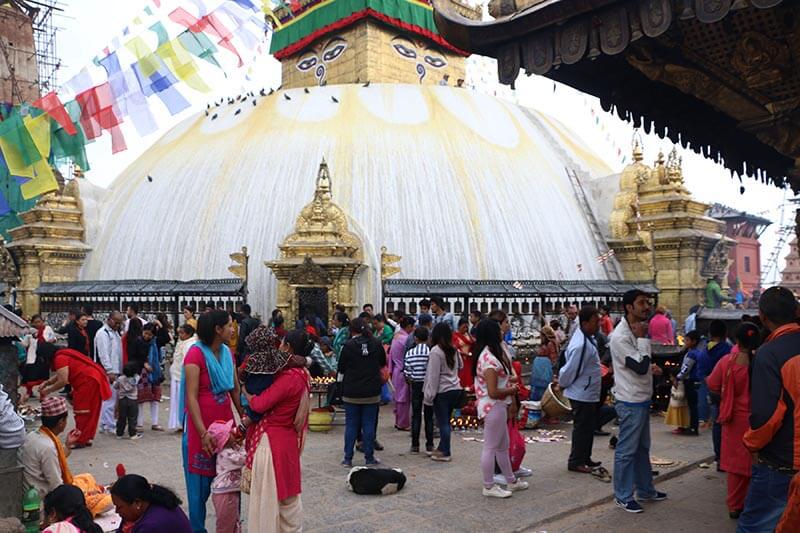
Your first full Nepal sightseeing day should focus on Kathmandu Valley’s cultural landmarks.
Possible stops include:
Swayambhunath
Often called the Monkey Temple, Swayambhunath stands on a hill overlooking the Kathmandu Valley. The Buddhist complex combines stupas, prayer wheels, shrines and sweeping city views.
Kathmandu Durbar Square
This historic palace area contains temples, traditional architecture and courtyards that reflect the city’s medieval past.
Pashupatinath Temple
Pashupatinath is one of Nepal’s most important Hindu pilgrimage sites. Visitors should behave respectfully because religious ceremonies and cremations take place along the Bagmati River.
Boudhanath Stupa
The immense Buddhist stupa is especially atmospheric in the late afternoon when pilgrims and monks walk clockwise around the monument.
Kathmandu’s combination of Hindu and Buddhist traditions is one of the strongest reasons to include Nepal after the Golden Triangle.
For additional planning ideas, explore Tusk Travel’s Kathmandu tour packages.
Overnight: Kathmandu
Day 9: Kathmandu to Pokhara
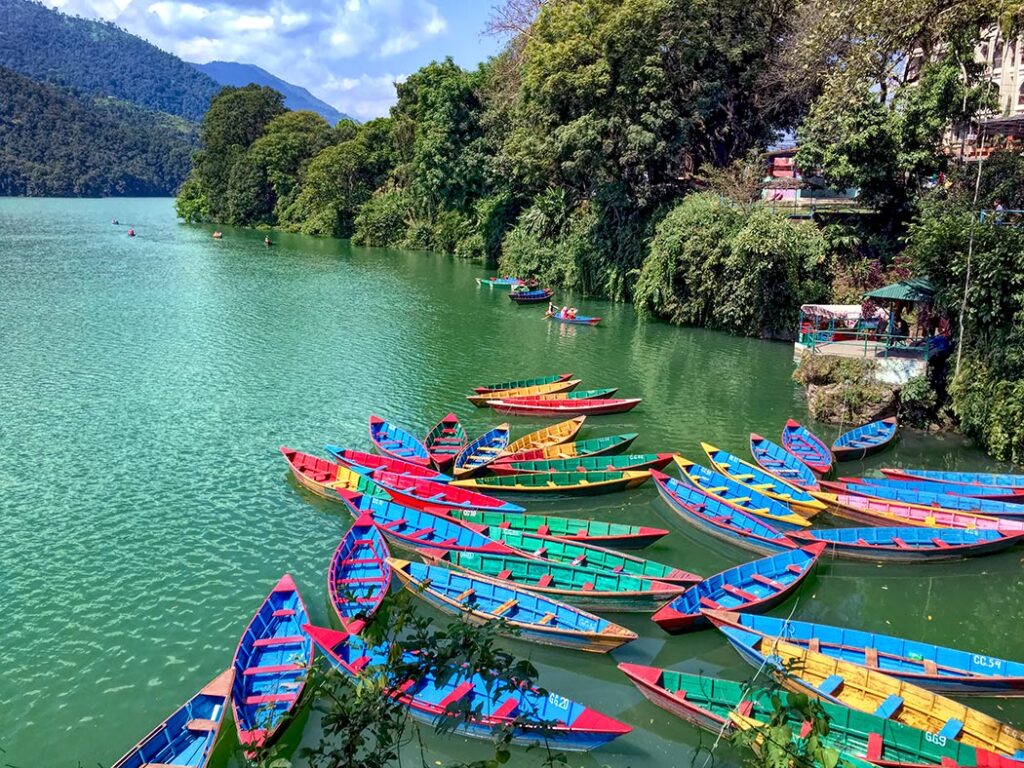
After breakfast, continue to Pokhara.
You generally have two main options: travel by road or take a domestic flight.
A flight is preferable when your itinerary is short because it saves valuable sightseeing time, although schedules can be affected by weather.
The road trip takes considerably longer but gives you a closer look at Nepal’s countryside, river valleys and small settlements.
Once in Pokhara, check into your hotel near the lakeside area.
Spend the evening walking beside Phewa Lake.
If conditions are good, take a boat ride and enjoy views toward the surrounding hills.
Pokhara provides a welcome pause after the monuments, markets and busy streets of Delhi, Jaipur, Agra and Kathmandu.
Overnight: Pokhara
Day 10: Explore Pokhara
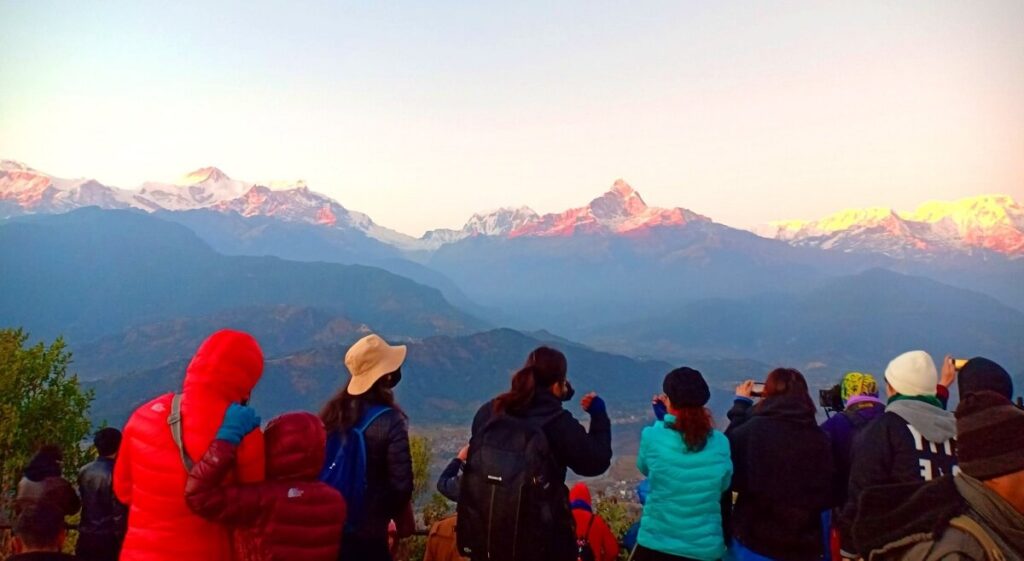
Rise early if you want to visit Sarangkot, famous for sunrise views over the Himalayan ranges when skies are clear.
After returning to the hotel for breakfast, continue exploring Pokhara.
Possible attractions include:
- Phewa Lake
- Davis Falls
- Gupteshwar Cave
- International Mountain Museum
- Bindhyabasini Temple
- World Peace Pagoda
You do not need to visit all of them.
Pokhara works best when part of the day remains unstructured. Sit beside the lake, enjoy a café, walk through the lakeside neighbourhood or simply appreciate the slower pace.
Travellers who have additional days could use Pokhara as a base for trekking, but a 12-day Golden Triangle and Nepal trip is better suited to cultural sightseeing and easy Himalayan experiences rather than a multi-day trek.
Overnight: Pokhara
Day 11: Pokhara to Kathmandu
Return to Kathmandu by flight or road.
If flying, keep some flexibility because Himalayan weather can occasionally affect domestic services.
After reaching Kathmandu, spend your final afternoon exploring whichever places you missed earlier.
Good possibilities include Patan, Bhaktapur, local handicraft shops or another walk around Thamel.
Bhaktapur is particularly attractive if you are interested in medieval Newari architecture, traditional squares and pottery.
Alternatively, use your final afternoon simply to relax.
After almost two weeks of travelling, an unscheduled evening can be more enjoyable than another packed sightseeing programme.
Overnight: Kathmandu
Day 12: Departure from Kathmandu
After breakfast, transfer to Tribhuvan International Airport for your onward flight.
Allow generous time for Kathmandu traffic and international check-in procedures.
Your 12-day Golden Triangle and Nepal tour ends here, having covered two countries and six major travel stages without requiring constant hotel changes.
Best Time for a Golden Triangle and Nepal Trip:
Choosing the right season matters because you are combining the plains of northern India with the Himalayan environment of Nepal.
October to November
This is arguably the best overall period.
Northern India is becoming cooler after the monsoon, while Nepal often experiences clearer skies and excellent mountain visibility.
October and November are therefore particularly attractive for travellers hoping to combine sightseeing with Himalayan scenery.
February to March
Late winter and early spring can also be excellent.
Delhi, Jaipur and Agra generally have comfortable sightseeing temperatures, while Nepal begins moving toward spring conditions.
March may also coincide with Holi celebrations, depending on the year.
December and January
These months offer cool temperatures in northern India and cold mornings in Nepal.
Kathmandu and Pokhara can be chilly early and late in the day, so pack layers.
Morning fog can occasionally affect transportation in northern India.
April to June
India becomes increasingly hot, especially in Delhi, Agra and Jaipur.
Sightseeing is still possible, but early starts become important.
Nepal is generally more comfortable, although temperatures rise before the monsoon.
July to September
Monsoon conditions affect both regions to varying degrees.
The landscapes become greener, and tourist numbers may be lower, but rain and cloud can reduce Himalayan visibility.
For most first-time travellers, October-November and February-March offer the best balance.
How Many Nights Should You Spend in Each Destination?
For this 12-day itinerary, a sensible distribution is:
- Delhi: 3 nights, including the return before Nepal
- Jaipur: 2 nights
- Agra: 1 night
- Kathmandu: 3 nights
- Pokhara: 2 nights
This provides enough time to see the essential sights without making the trip exhausting.
Many travellers make the mistake of adding Varanasi, Chitwan, Udaipur or another Himalayan destination to the same 12-day itinerary.
Although technically possible, the result becomes rushed.
If you have only 12 days, prioritize quality over quantity.
Travellers planning their first India trip can also compare Tusk Travel’s first-time India tour ideas. The current collection includes India-Nepal combinations alongside classic India itineraries.
India to Nepal: Flight or Overland?
For a short Golden Triangle and Nepal holiday, fly.
Delhi and Kathmandu have frequent nonstop connections, making air travel far more efficient than travelling overland.
An overland journey may appeal to travellers with three weeks or more, particularly those visiting Varanasi, Lumbini or Chitwan.
For a 12-day itinerary, however, travelling by road across the India-Nepal border consumes too much time.
Flying also allows you to place Nepal naturally after completing the Golden Triangle.
Visa Planning for India and Nepal
Visa rules depend on nationality, so always verify requirements using official government sources before travelling.
India
Many nationalities can apply for an Indian e-Visa for tourism. Eligibility varies by passport, and the official Indian e-Visa service maintains the current list of eligible countries.
Apply through the official government portal and avoid relying solely on unofficial visa websites.
Nepal
Nepal currently offers tourist visa-on-arrival facilities at Tribhuvan International Airport for many eligible international travellers. The Department of Immigration states that tourist visas may also be obtained through Nepalese diplomatic missions before arrival.
Current official visa-on-arrival fees listed by Nepal’s Department of Immigration include:
- 15 days: US$30
- 30 days: US$50
- 90 days: US$125
These policies can change, so check again shortly before departure.
Transportation Around the Golden Triangle
A private air-conditioned vehicle with an experienced driver is one of the easiest ways to travel between Delhi, Jaipur and Agra.
It allows greater flexibility than fixed bus schedules and avoids repeatedly handling luggage at railway stations.
For certain sectors, trains can also be useful.
Delhi and Agra, for example, have fast rail connections. Tusk Travel’s Agra guide notes that popular express trains provide convenient access between the two cities.
For a complete Golden Triangle circuit, however, a private car often provides the most straightforward experience.
Where Should You Stay?
You do not need luxury hotels throughout the trip to have a comfortable journey.
Well-selected 4-star hotels or quality heritage properties can provide an excellent balance between comfort and value.
Delhi
Choose a convenient central area with good road access.
Jaipur
A heritage-style hotel can add character to your Rajasthan experience.
Agra
Consider staying reasonably close to the Taj Mahal, especially if planning a sunrise visit.
Kathmandu
Thamel is convenient for restaurants, shopping and first-time visitors, while quieter neighbourhoods suit travellers seeking more peaceful surroundings.
Pokhara
Staying around Lakeside keeps restaurants, cafés, shops and Phewa Lake within easy reach.
What Should You Pack?
Packing for India and Nepal requires flexibility because temperatures may vary significantly.
Useful items include:
- comfortable walking shoes
- breathable daytime clothing
- light jacket or fleece for Nepal
- scarf or shawl for religious sites
- sunscreen
- hat
- sunglasses
- personal medication
- reusable water bottle
- small day bag
- power adapter
- portable charger
During winter, bring warmer layers for Kathmandu and Pokhara.
During warmer months, lightweight clothing is more important in Delhi, Agra and Jaipur.
Modest clothing is advisable when visiting temples, mosques and other religious sites.
Food and Drinking Water
Food is one of the pleasures of this journey.
In Delhi, try North Indian dishes, kebabs, breads and carefully selected street-food experiences.
Jaipur introduces Rajasthani flavours such as dal baati churma, gatte ki sabzi and regional thalis.
Agra is famous for petha as well as Mughlai-influenced dishes.
Once in Nepal, try:
- momos
- dal bhat
- Newari cuisine
- thukpa
- sel roti
- traditional Nepali tea
Use bottled or properly filtered drinking water throughout your journey.
Travellers with sensitive stomachs should be selective about raw foods, ice and very spicy street dishes.
How Much Should You Try to See?
The most important rule when planning a Golden Triangle with Nepal in 12 days is not to confuse a long sightseeing list with a good itinerary.
Your journey already includes:
- two countries
- four historic cities
- Himalayan scenery
- the Taj Mahal
- several UNESCO heritage areas
- Mughal architecture
- Rajput palaces
- Hindu temples
- Buddhist stupas
- mountain landscapes
That is already a substantial holiday.
Adding Varanasi, Udaipur, Chitwan and Lumbini might look attractive on paper, but each additional destination creates another transfer and hotel change.
If you want to include those places, increase the trip to at least 15 to 18 days.
Practical Tips for Planning the Trip
- Book international flights before domestic transport, particularly if travelling during October, November, Christmas, New Year or other busy holiday periods.
- Reserve your Taj Mahal visit carefully and remember that monument schedules and closures should be verified before finalizing the itinerary.
- Keep your Delhi-Kathmandu flight separate from a long road transfer on the same day.
- Build flexibility into Nepal domestic travel because weather can affect flight schedules.
- Carry copies of important travel documents both digitally and physically.
- Purchase comprehensive travel insurance covering both India and Nepal.
- Most importantly, do not schedule sightseeing from sunrise until late evening every day. A two-country journey becomes far more enjoyable when meals, rest and spontaneous exploration remain part of the itinerary.
For broader destination inspiration, the Tusk Travel Blog contains dedicated India, Nepal, Golden Triangle and practical travel sections.
You can also read Tusk Travel’s step-by-step Nepal trip planning guide for additional Nepal preparation advice.
Frequently Asked Questions About a 12-Day Golden Triangle & Nepal Trip
Is 12 days enough for the Golden Triangle and Nepal?
Yes. Twelve days is enough for Delhi, Jaipur, Agra, Kathmandu and Pokhara if the itinerary is carefully planned. Avoid adding too many additional destinations.
What is the best route for a Golden Triangle and Nepal trip?
A practical route is Delhi → Jaipur → Agra → Delhi → Kathmandu → Pokhara → Kathmandu. It minimizes unnecessary backtracking and uses Delhi as the convenient air connection to Nepal.
Should I visit India or Nepal first?
India first usually works well because you can complete the Golden Triangle and then fly directly from Delhi to Kathmandu. Nepal’s slower pace also provides a pleasant ending after the busy sightseeing days in India.
What is the best month for the Golden Triangle and Nepal?
October and November are among the best months because northern India generally has pleasant sightseeing conditions and Nepal often enjoys clearer Himalayan views. February and March are another attractive period.
Can I travel from Delhi to Kathmandu by road?
Yes, overland travel is possible, but it takes much longer. For a 12-day itinerary, flying is considerably more practical.
Should I include Pokhara?
Yes, if Himalayan landscapes interest you. Pokhara adds lakes, mountains and a relaxed atmosphere that contrasts beautifully with Delhi, Jaipur, Agra and Kathmandu.
Can this trip be customized?
Absolutely. Travellers with extra time could add Ranthambore, Varanasi, Chitwan, Lumbini, Udaipur or additional Himalayan destinations. Tusk Travel’s Nepal tour package collection and Golden Triangle itineraries provide useful starting points for different combinations.
Final Thoughts
A 12-day Golden Triangle and Nepal trip gives first-time visitors an impressive introduction to both India and Nepal without requiring several weeks of travel.
The journey begins among Delhi’s historic monuments and busy markets, continues through Jaipur’s royal palaces and Agra’s magnificent Taj Mahal, and then changes completely as you cross into Nepal.
Kathmandu introduces ancient temples, Buddhist stupas and living Himalayan culture, while Pokhara finishes the journey with lakes, mountains and a noticeably slower rhythm.
The key to planning the trip successfully is resisting the temptation to see everything.
Give Delhi, Jaipur and Kathmandu enough time. Spend a night in Agra rather than racing through the Taj Mahal. Fly between India and Nepal rather than losing valuable days overland. And allow Pokhara to be a place where you actually slow down.
With the right pacing, 12 days in India and Nepal can feel surprisingly complete: two countries, extraordinary architecture, spiritual traditions, local food, colourful markets, royal history and the landscapes of the Himalayas, all within one carefully designed journey.
