
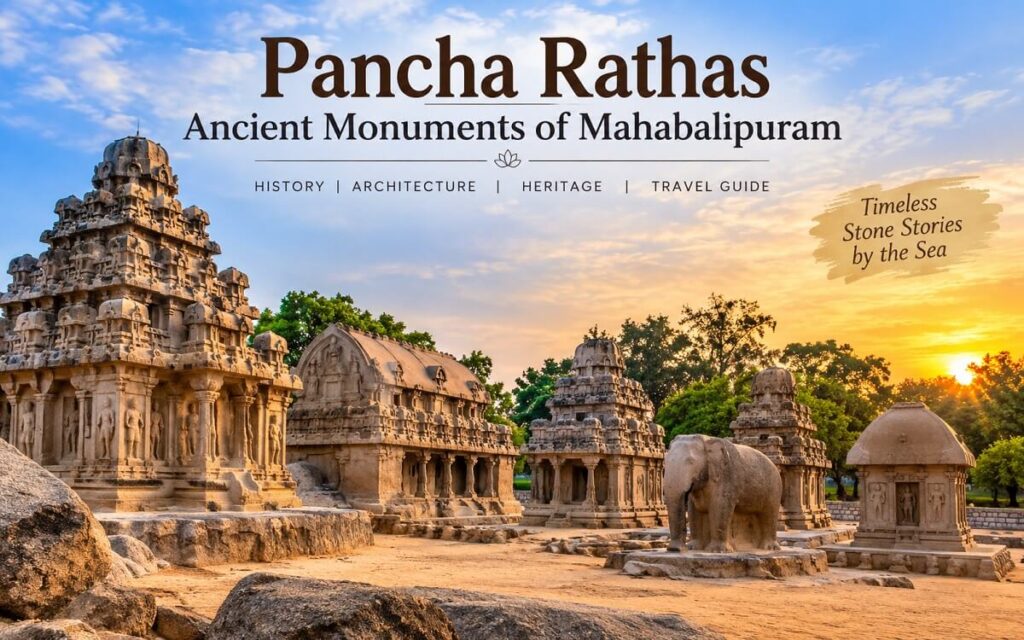
Mahabalipuram is filled with extraordinary stone monuments, but few reveal the creativity of the Pallava craftsmen as clearly as the Pancha Rathas. Standing together in an open archaeological complex near the Coromandel Coast of Tamil Nadu, these five monolithic structures look almost as though enormous stone temples were placed beside one another.
The reality is even more impressive. Each ratha was carved directly from a massive natural rock rather than constructed by stacking individual blocks of stone.
Also known as the Five Rathas or Pandava Rathas, the monuments form part of the UNESCO-listed Group of Monuments at Mahabalipuram. The wider heritage complex contains rock-cut caves, monolithic shrines, enormous open-air reliefs and structural temples created during the Pallava period in the 7th and 8th centuries.
For travellers interested in archaeology, sculpture or early South Indian architecture, visiting the Pancha Rathas is one of the highlights of exploring Mahabalipuram tour packages.
This complete guide explains the history of the Pancha Rathas, their architecture, the five individual monuments, what to look for during your visit and how to include them in a wider Tamil Nadu journey.
What Are the Pancha Rathas?
The word “Pancha” means five, while ratha traditionally means chariot. Pancha Rathas therefore translates as “Five Chariots.”
However, the monuments are not actual chariots.
They are five monolithic structures carved to resemble different types of early South Indian shrines. UNESCO describes the rathas of Mahabalipuram as monolithic temples hewn from large boulders, displaying different plans, elevations and architectural forms.
The five structures are popularly known as:
- Dharmaraja Ratha
- Bhima Ratha
- Arjuna Ratha
- Nakula-Sahadeva Ratha
- Draupadi Ratha
Their names come from the Pandava brothers and Draupadi of the Indian epic Mahabharata. The names, however, were attached to them later and do not mean that the structures were originally constructed for these characters.
Another important point often missed in travel descriptions is that the Pancha Rathas were apparently never completed and were not consecrated as functioning temples. They are better understood as remarkable experiments in temple architecture carved
permanently into granite.
You can discover more monuments in the town through Tusk Travel’s guide to the famous temples and monuments of Mahabalipuram.
History of Pancha Rathas
The Pancha Rathas belong to the era of the Pallava dynasty, one of the most influential powers in southern India.
Mahabalipuram, also called Mamallapuram, developed into an important Pallava cultural and maritime centre. The Pallava rulers encouraged architects and sculptors to experiment extensively with rock-cut architecture.
UNESCO places the monuments of Mahabalipuram broadly in the 7th and 8th centuries and identifies innovations in rock architecture with the reign of Narasimhavarman I, known as Mamalla.
Instead of constructing a building from the ground upward, artisans working on the rathas removed unwanted granite until the architectural form emerged from the original rock.
Imagine beginning with an enormous boulder and having to visualize the columns, walls, sculptures, roof and internal spaces before carving too deeply. A major mistake could not simply be replaced with another block.
This subtractive technique helps explain why the Pancha Rathas remain such impressive examples of ancient Indian craftsmanship.
Why Are the Pancha Rathas Important?
The importance of Pancha Rathas goes beyond their age.
Each structure presents a somewhat different architectural solution. Their roofs, plans, towers, decorative details and proportions vary considerably.
Together, they provide a fascinating look at the experimentation that contributed to the development of Dravidian temple architecture.
Mahabalipuram’s monuments were inscribed as a UNESCO World Heritage Site in 1984. UNESCO recognizes the site for its artistic achievement, its testimony to Pallava civilization and its architectural and cultural influence.
For architecture enthusiasts, the rathas are especially valuable because visitors can walk around the structures and examine different forms from several angles.
1. Dharmaraja Ratha
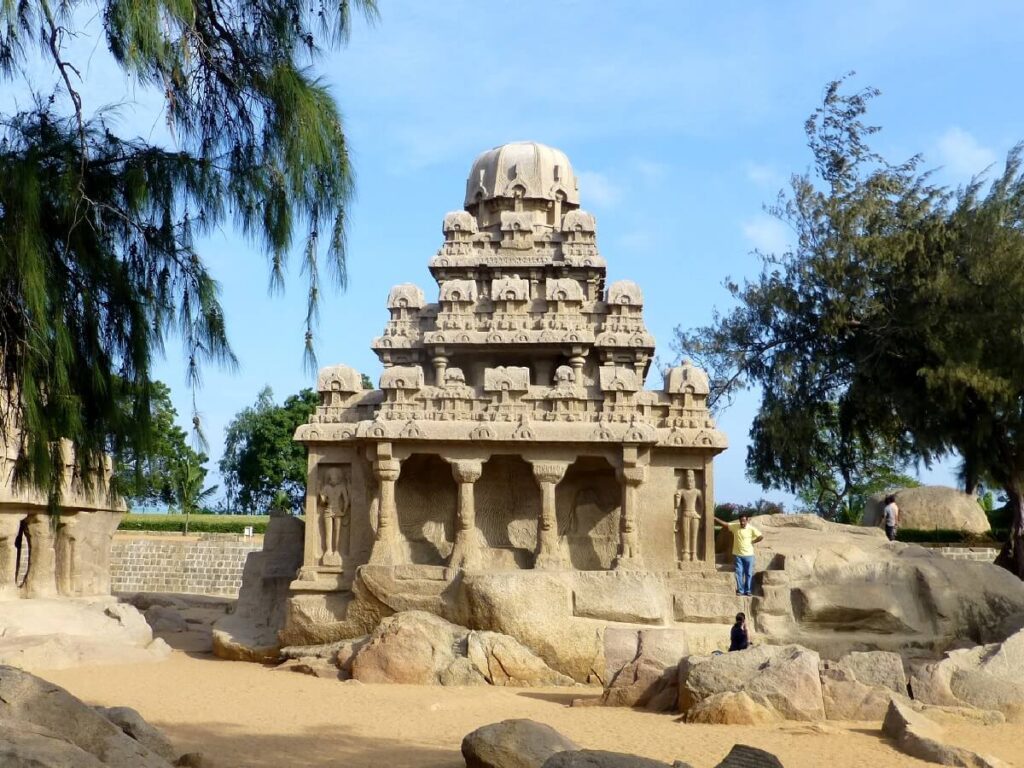
The Dharmaraja Ratha is the tallest and one of the most visually impressive structures in the complex.
It has a multi-level pyramidal appearance that immediately recalls the towers associated with later South Indian temple architecture. Rows of miniature architectural elements, sculpted figures and carefully carved details make it worth examining slowly rather than simply photographing from a distance.
The vertical composition gives the monument a sense of height despite its relatively compact footprint.
Look carefully at the wall niches and sculpted figures as you walk around it. These details demonstrate how Pallava artists were combining architecture and sculpture rather than treating them as separate art forms.
For travellers studying the evolution of South Indian temple design, Dharmaraja Ratha is arguably the most important monument in the group.
2. Bhima Ratha
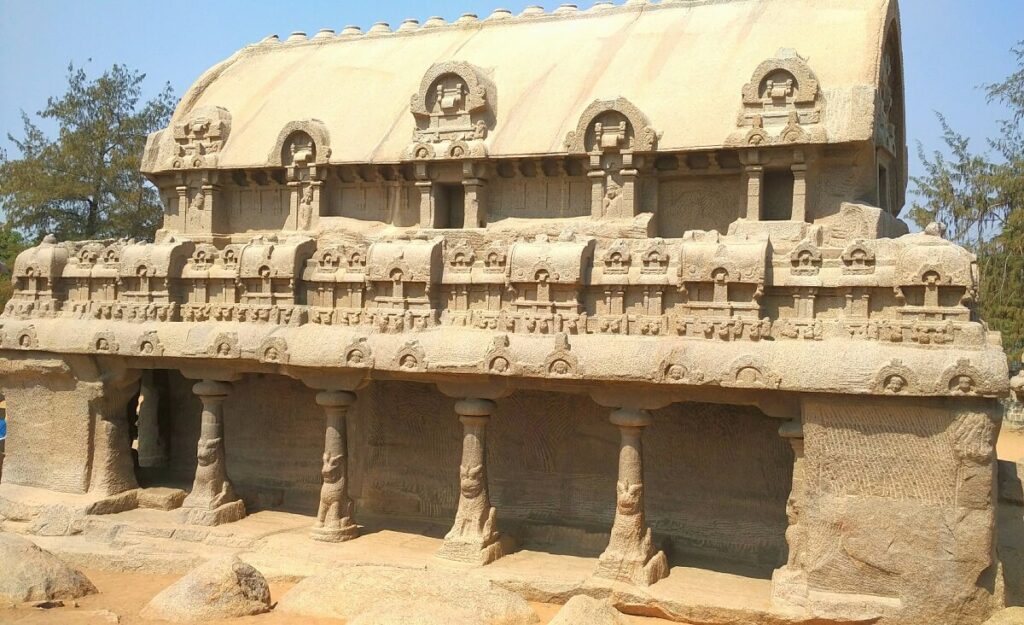
Standing nearby, Bhima Ratha looks dramatically different.
Rather than emphasizing vertical height, it has an elongated rectangular body and a long barrel-shaped roof. Its form gives it a heavier and more horizontal appearance than Dharmaraja Ratha.
The contrast between the two structures is precisely what makes the Pancha Rathas complex so interesting.
Visitors sometimes expect five almost identical “chariots.” Instead, they encounter a collection of architectural experiments.
The Bhima Ratha is especially useful for appreciating how ancient designers explored different roof shapes while still working within the limitations of a single mass of stone.
Walk around the entire monument if access conditions allow. The side profile makes its unusual roof structure particularly easy to understand.
3. Arjuna Ratha
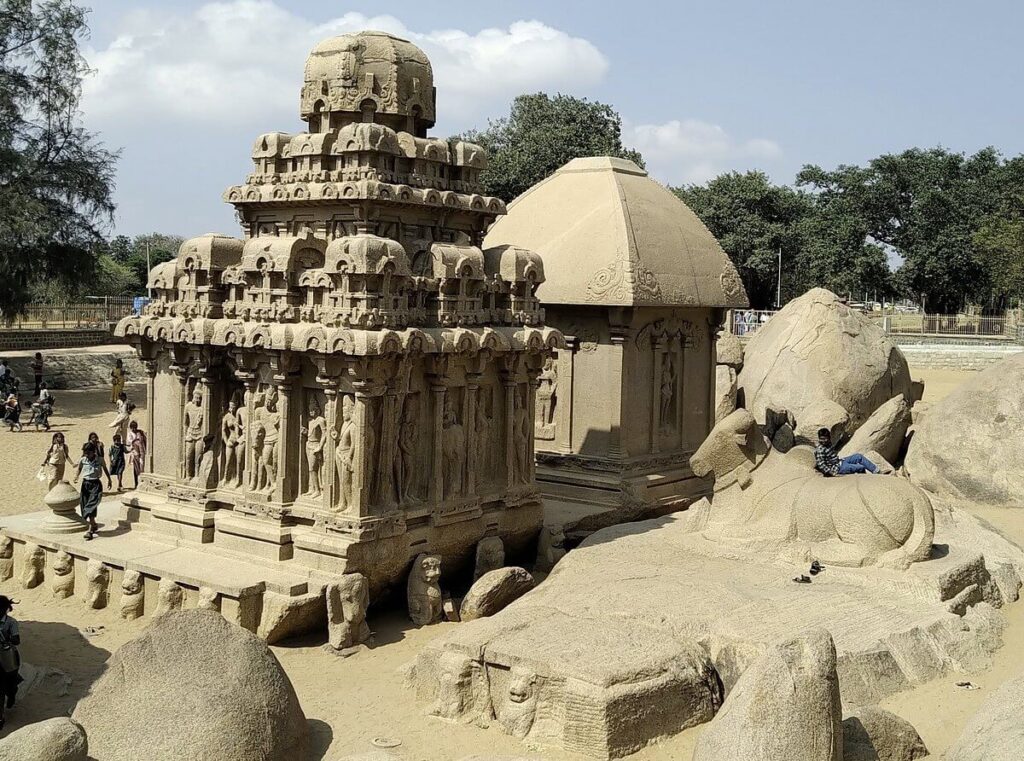
The Arjuna Ratha is smaller than Dharmaraja Ratha but beautifully proportioned.
It resembles a compact shrine with a tiered tower above its square plan. Decorative elements, niches and sculptural details give it an elegant appearance.
The structure demonstrates how a complete temple-like form could be translated into a single piece of stone.
The Arjuna Ratha stands close to Draupadi Ratha, allowing visitors to compare two strikingly different approaches to shrine design within only a few steps.
It is these side-by-side differences that make Pancha Rathas feel almost like an outdoor architectural workshop created in granite.
4. Draupadi Ratha
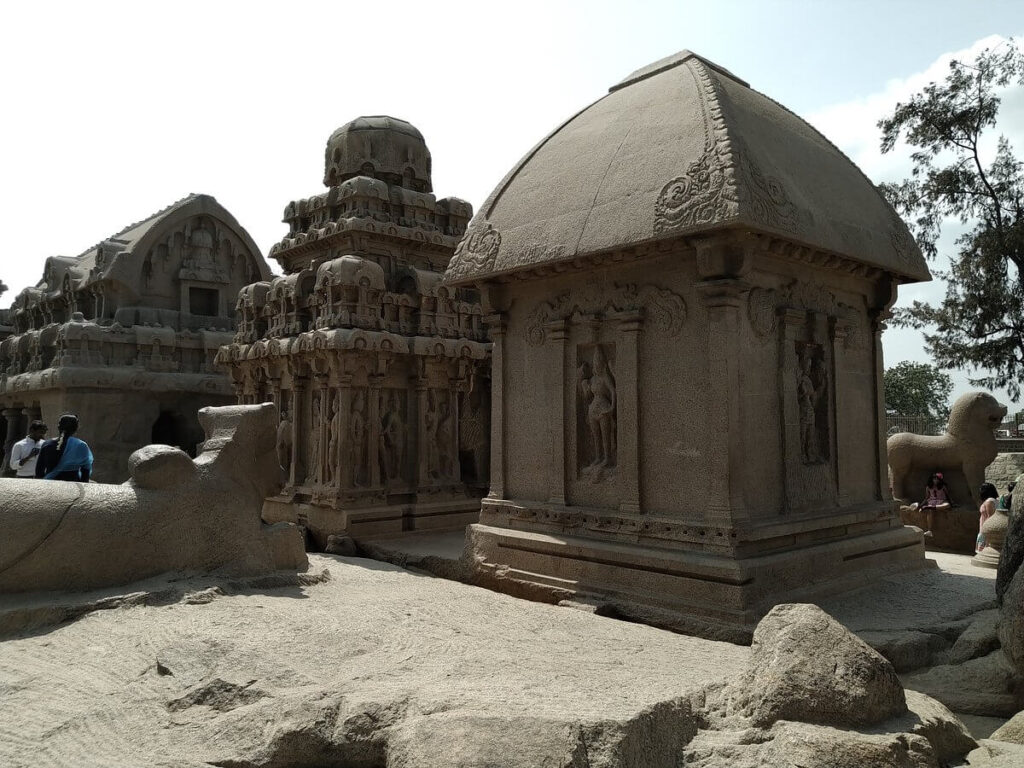
The Draupadi Ratha is the smallest of the five, but its simplicity makes it one of the easiest structures to appreciate.
Its form resembles a small hut with a curved roof rather than a towering temple.
The shrine is associated visually with the goddess Durga, whose imagery appears in its sculptural programme.
Its modest scale stands in sharp contrast to the larger rathas nearby.
The comparison is important because it demonstrates that monumentality was not the only concern of Pallava architecture. Even a small shrine could be carefully proportioned and decorated.
Visitors interested in sculpture should spend a little extra time examining the religious imagery here.
5. Nakula-Sahadeva Ratha
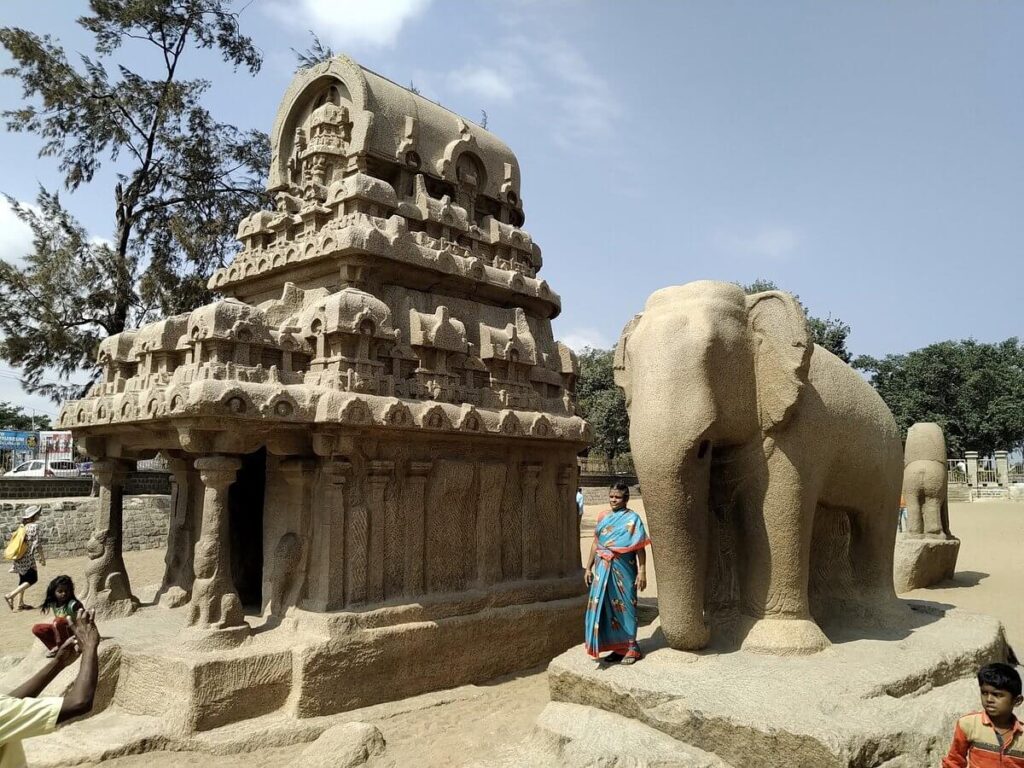
The Nakula-Sahadeva Ratha has another distinctive architectural profile and is positioned separately enough to reveal its form clearly.
One of the most memorable features of this part of the complex is the nearby monolithic elephant sculpture.
The life-sized stone elephant often becomes a favourite subject for photographers. More importantly, it shows the sculptors’ ability to move comfortably between architectural forms and naturalistic animal sculpture.
When viewing the monument and elephant together, notice the sense of volume achieved purely by removing stone from the original rock masses.
The Famous Stone Elephant
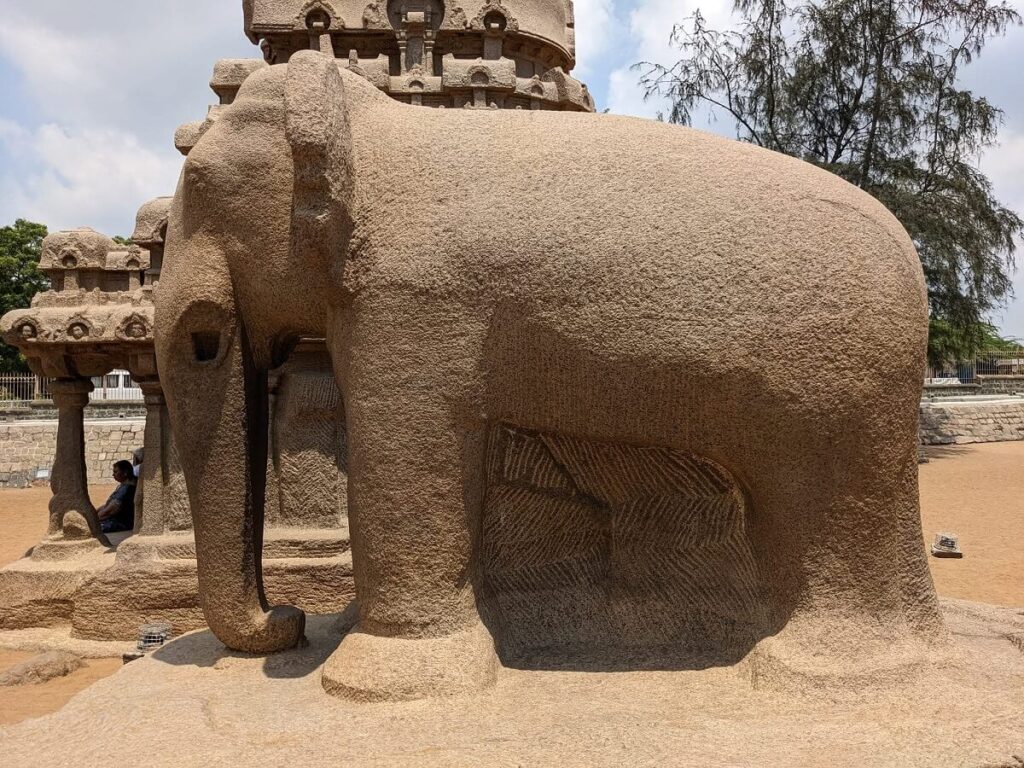
Even travellers who know little about Pallava architecture tend to remember the elephant at Pancha Rathas.
Carved from stone, the elephant appears remarkably natural when viewed from several directions.
Its curved back, broad body, trunk and legs demonstrate how carefully the sculptors observed real animals.
The sculpture also provides visitors with a useful sense of scale. Standing beside such enormous carved forms makes it easier to appreciate how ambitious the entire project was.
Photography is particularly rewarding in this area during softer morning or late-afternoon light.
Architecture of Pancha Rathas
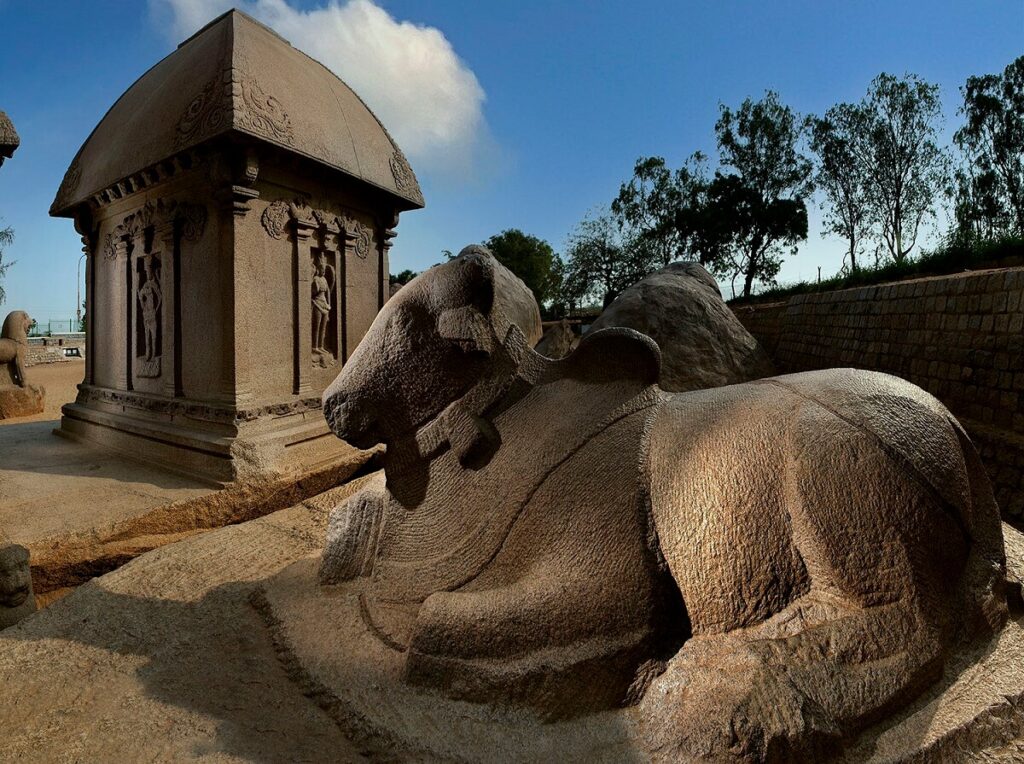
The biggest architectural lesson of Pancha Rathas is variety.
Rather than repeating one standard design, the builders experimented with several forms. UNESCO notes that the monolithic rathas display variations in both ground plan and elevation and are richly decorated with architectural motifs and sculptures.
You can observe:
- Pyramidal towers
- Barrel-shaped roofs
- Hut-like roof forms
- Pillared façades
- Sculpted niches
- Human figures
- Hindu deities
- Animal sculptures
- Decorative architectural motifs
These features make the site especially useful for anyone trying to understand how South Indian architecture developed.
The Pancha Rathas should therefore not be viewed merely as five individual monuments. Together they form an architectural study carved into stone.
For more context, see Tusk Travel’s guide to the architectural marvels of Tamil Nadu.
Are Pancha Rathas Really Temples?
They are commonly called monolithic temples, but this description needs some explanation.
The structures take the architectural form of temples and contain religious sculptures, but they apparently remained unfinished and were never consecrated for regular worship.
So unlike many historic temples in Tamil Nadu, visitors do not come to Pancha Rathas primarily for rituals or prayer.
They come to experience an archaeological and architectural monument.
This also makes the atmosphere different. You can focus closely on the design, carving techniques and relationship between each structure without the activity normally associated with a functioning temple.
Best Time to Visit Pancha Rathas
The most comfortable period to explore Mahabalipuram is generally November to February, when temperatures are relatively pleasant for outdoor sightseeing. Tusk Travel also recommends these months for exploring Mahabalipuram’s monuments.
Because Pancha Rathas is largely an open-air attraction, the time of day matters.
Early morning is excellent for cooler weather, relatively fewer visitors and photography.
Late afternoon offers softer light on the granite and is also more pleasant than the midday heat.
If visiting from March onward, carry drinking water, sunglasses, a hat and sun protection.
How Long Do You Need at Pancha Rathas?
Allow around 45 minutes to one hour for a comfortable visit.
Travellers seriously interested in architecture or photography may easily spend longer.
Do not rush through merely to photograph all five monuments. Walk around each ratha and compare its roof, shape, façade and sculptures with those of its neighbours.
Mahabalipuram itself deserves at least a full day, while an overnight stay provides a more relaxed experience.
How to Reach Pancha Rathas
Mahabalipuram lies approximately 60 km from Chennai and is easily reached by road. Tusk Travel notes that the scenic East Coast Road is a popular route between Chennai and Mahabalipuram.
From Chennai
A private car or taxi is usually the easiest option for travellers combining several monuments in one day.
For detailed transportation information, read the guide on how to reach Mahabalipuram from Chennai.
By Air
Chennai International Airport is the main airport for travellers arriving from other parts of India or overseas.
By Train
Mahabalipuram does not have a major railway station of its own. Chengalpattu is one of the nearby rail connections, after which travellers can continue by road.
Places to Visit Near Pancha Rathas:
Pancha Rathas should ideally be combined with other archaeological treasures around Mamallapuram.
Shore Temple
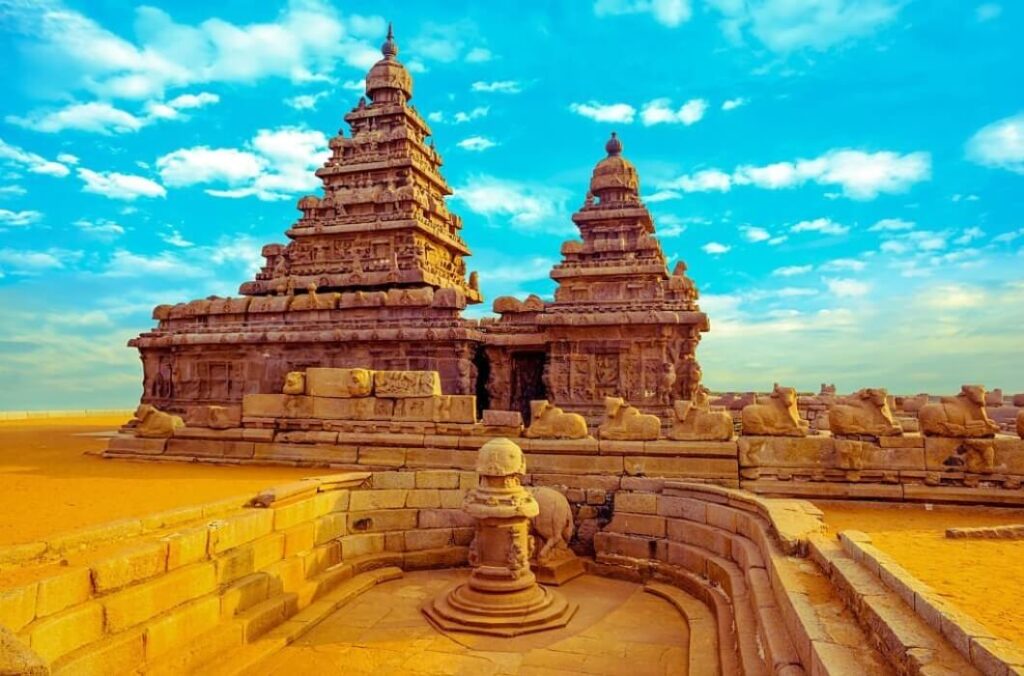
Standing beside the Bay of Bengal, the Shore Temple represents a different stage of Pallava architecture because it is a structural temple rather than a monument carved completely from a boulder.
Read more in the detailed Shore Temple Mahabalipuram guide.
Arjuna’s Penance
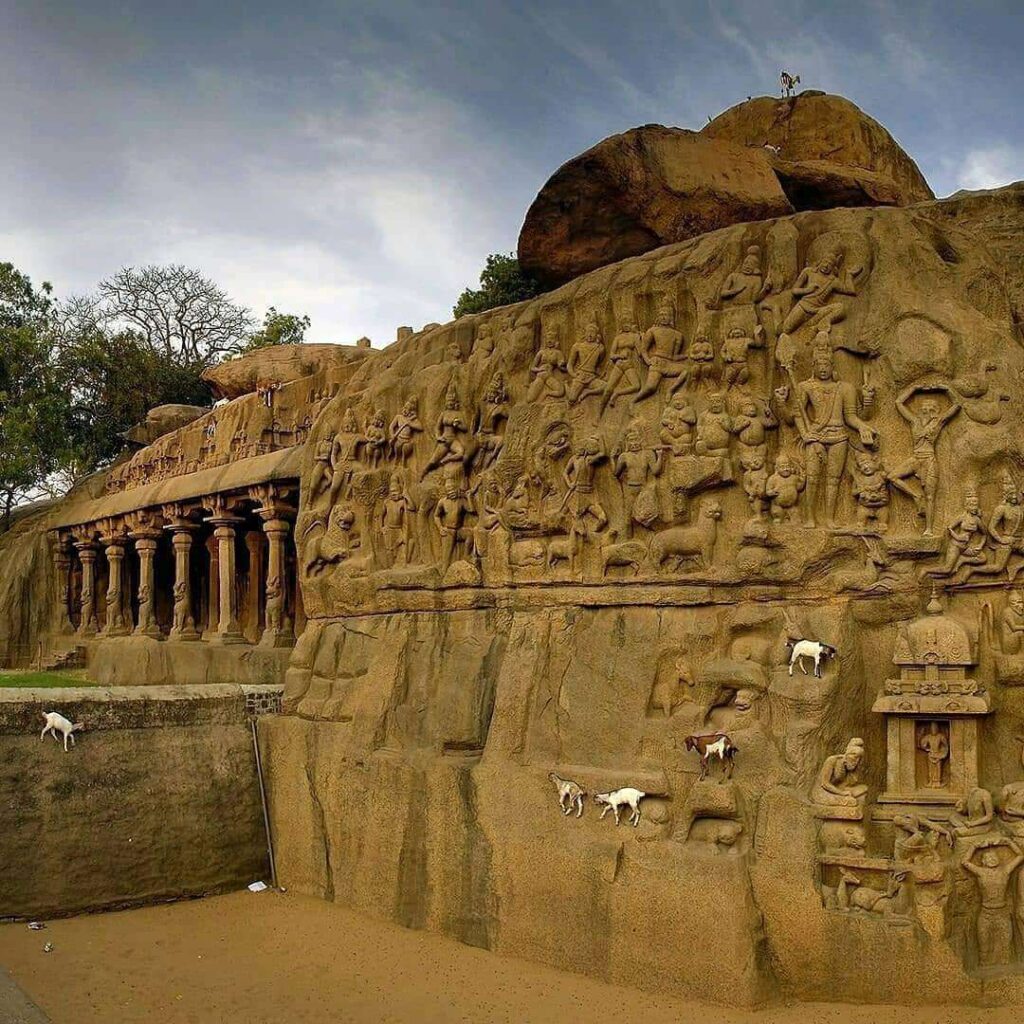
This enormous open-air rock relief is one of Mahabalipuram’s masterpieces. Its crowded composition contains gods, humans, animals and mythological imagery.
Krishna’s Butter Ball
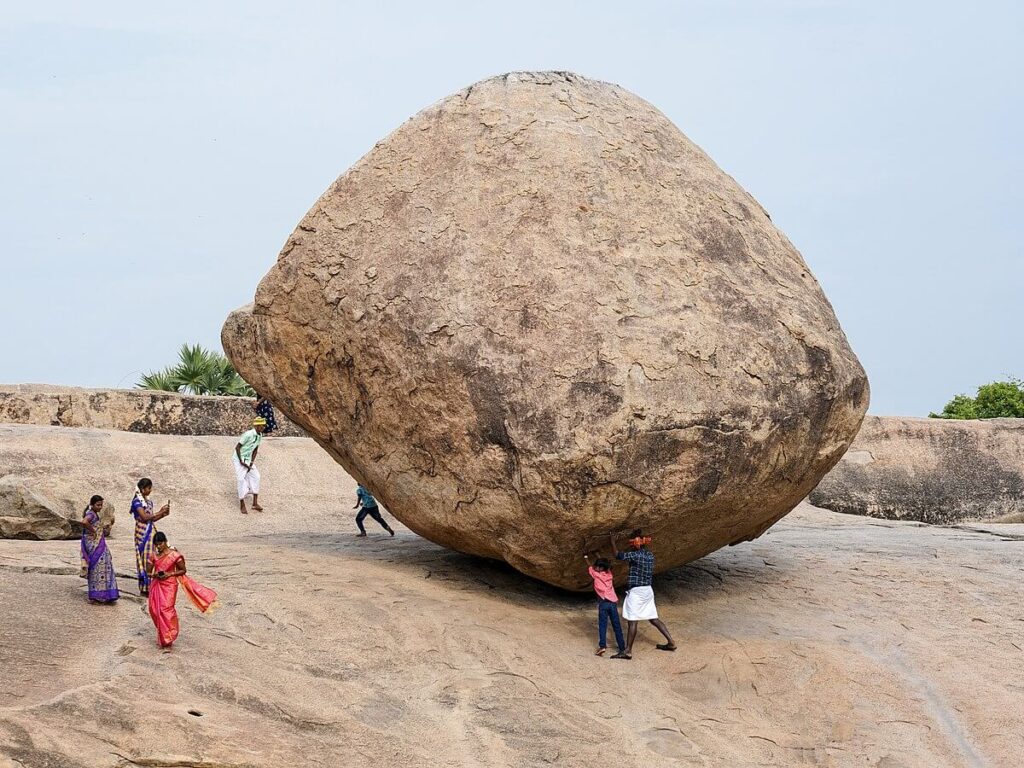
This huge naturally balanced boulder provides a completely different experience from the archaeological monuments and is particularly popular with families and photographers.
Cave Temples
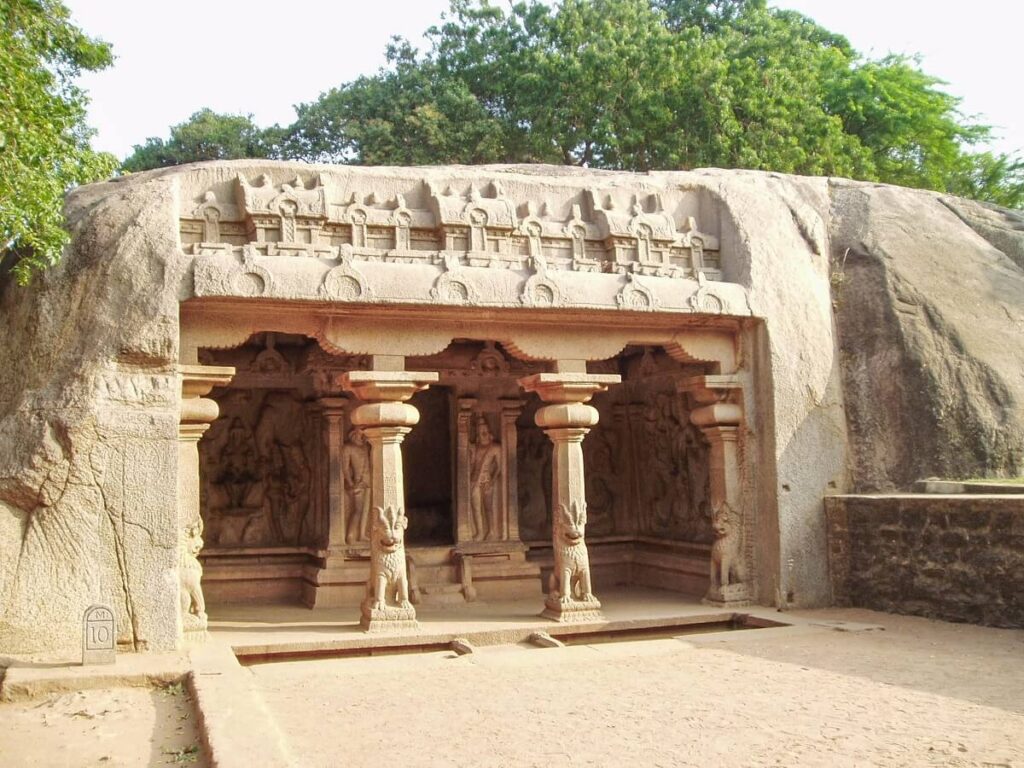
Varaha Cave, Mahishasuramardini Cave and other rock-cut monuments reveal another side of Pallava craftsmanship.
You can plan the sightseeing sequence using Tusk Travel’s guide to the best places to visit in Mahabalipuram.
Combining Mahabalipuram with a Tamil Nadu Tour
Mahabalipuram works particularly well as part of a longer South India itinerary.
A popular route can begin in Chennai and continue through Mahabalipuram, Kanchipuram and Pondicherry, followed by important destinations farther south such as Thanjavur, Trichy, Madurai and Rameswaram.
Travellers with more time can also combine Tamil Nadu’s temple heritage with Kerala.
Tusk Travel offers a range of Tamil Nadu tour packages covering cultural, temple and South India itineraries. Some itineraries specifically connect Chennai, Kanchipuram, Mahabalipuram and Pondicherry, making it easy to incorporate the Five Rathas into a broader journey.
Practical Tips for Visiting Pancha Rathas
Wear comfortable footwear because you will spend most of your visit walking outdoors. Visit early or later in the afternoon if possible, particularly during warmer months.
Carry water and sun protection, but avoid touching or climbing on sculptures and historic structures. These monuments have survived for more than a thousand years and should be treated accordingly.
A knowledgeable local guide can also make a major difference. Without context, visitors mainly see beautiful stone buildings. With an explanation of the architectural forms, Pallava history and carving techniques, the site becomes far more meaningful.
Photography enthusiasts should also look beyond wide-angle views. Doorways, miniature architectural details, stone animals, sculpted figures and the contrasting roof forms offer excellent close-up compositions.
Why Pancha Rathas Is Worth Visiting
Mahabalipuram has several internationally recognized monuments, so it can be tempting to focus primarily on the famous Shore Temple.
That would be a mistake.
Pancha Rathas offers something different.
Here, visitors can see ancient architects experimenting with temple forms almost side by side. A small hut-like shrine stands near sophisticated multi-tiered towers. A long barrel-roofed monument contrasts with compact pyramidal structures. Stone elephants and religious figures bring life to the otherwise solid granite landscape.
The monuments also demonstrate something fundamental about Mahabalipuram: its builders were not simply repeating established designs. They were experimenting.
More than thirteen centuries later, those experiments remain visible.
Frequently Asked Questions About Pancha Rathas
1. What is special about Pancha Rathas in Mahabalipuram?
Pancha Rathas consists of five monolithic temple-form monuments carved from large granite boulders. Each presents a different architectural form, making the complex particularly important for understanding early Dravidian architecture.
2. Who built the Pancha Rathas?
The monuments belong to the Pallava period and are generally associated with the architectural experimentation that flourished during the 7th century, particularly around the reign of Narasimhavarman I Mamalla.
3. Are the Pancha Rathas dedicated to the Pandavas?
Despite their modern names, the monuments were not originally built as shrines to the Pandavas. The names Dharmaraja, Bhima, Arjuna, Nakula-Sahadeva and Draupadi were attached to the structures through later tradition.
4. Were the Pancha Rathas used as temples?
Although they resemble temples and contain religious imagery, they appear to have remained unfinished and were not consecrated as functioning temples.
5. Is Pancha Rathas a UNESCO World Heritage Site?
Yes. Pancha Rathas forms part of the Group of Monuments at Mahabalipuram, which UNESCO inscribed on the World Heritage List in 1984.
6. How much time should I spend at Pancha Rathas?
Around 45 minutes to one hour is sufficient for most visitors. Architecture enthusiasts and photographers may want additional time to study individual sculptures and different sides of the monuments.
7. Can I visit Pancha Rathas on a day trip from Chennai?
Yes. Mahabalipuram is around 60 km from Chennai and is one of the most popular cultural day trips from the city. A full day allows you to combine Pancha Rathas with Shore Temple, Arjuna’s Penance, Krishna’s Butter Ball and nearby cave monuments.
Final Thoughts
The Pancha Rathas in Mahabalipuram are much more than five impressive stone monuments. They represent a period when Pallava architects were exploring ideas that would influence the development of South Indian temple architecture.
Carved directly from massive granite rocks, each ratha presents a distinct design. Together with the remarkable stone elephant and surrounding sculptures, the complex feels like an architectural gallery created more than a thousand years ago.
Combine Pancha Rathas with the Shore Temple, Arjuna’s Penance and Mahabalipuram’s cave sanctuaries and you begin to understand why the town holds such an important place in Indian architectural history.
Whether you are interested in archaeology, photography, ancient Indian history or simply looking for the most memorable places to include in a Tamil Nadu itinerary, Pancha Rathas deserves a prominent place on your Mahabalipuram travel plan.
