
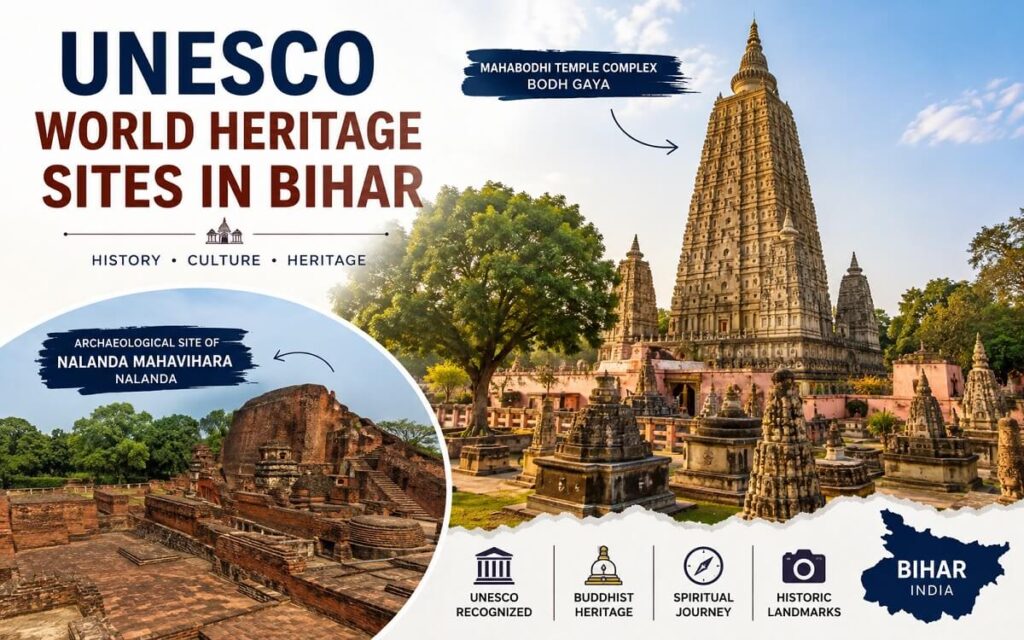
Bihar is one of those destinations in India where history does not feel distant. Ancient universities, Buddhist monasteries, sacred trees, stupas, temples, archaeological ruins and pilgrimage towns are scattered across a landscape that once shaped some of the most influential ideas in Asian civilization.
For travelers interested in history and culture, the UNESCO World Heritage Sites in Bihar provide an extraordinary introduction to this legacy. The state currently has two properties inscribed on the UNESCO World Heritage List: the Mahabodhi Temple Complex at Bodh Gaya and the Archaeological Site of Nalanda Mahavihara at Nalanda. Both are closely connected with Buddhism, yet they offer very different experiences.
Bodh Gaya represents one of Buddhism’s most sacred moments: the enlightenment of Siddhartha Gautama. Nalanda, on the other hand, represents centuries of organized scholarship, monastic life and intellectual exchange.
Together, they reveal how Bihar was not merely a political center in ancient India. It was also a place where religious thought, education, philosophy and international cultural exchange flourished.
If you are planning a cultural or spiritual journey through eastern India, these UNESCO sites, combined with nearby Rajgir, Vaishali, Pawapuri and other historical destinations, can create one of India’s most rewarding heritage routes.
How Many UNESCO World Heritage Sites Are There in Bihar?
Bihar has two UNESCO World Heritage Sites:
- Mahabodhi Temple Complex at Bodh Gaya
- Archaeological Site of Nalanda Mahavihara at Nalanda
The Mahabodhi Temple Complex was inscribed on the UNESCO World Heritage List in 2002, while Nalanda Mahavihara was added in 2016. UNESCO recognizes Mahabodhi for its exceptional historical, architectural and spiritual connection with Buddha’s enlightenment, while Nalanda is recognized for its contribution to monastic education, architecture and the transmission of knowledge.
Several other historical places in Bihar, including Rajgir, Vaishali, Vikramshila and Kesaria, are also extremely important culturally. However, travelers should not confuse them with officially inscribed UNESCO World Heritage properties.
Let us explore Bihar’s two UNESCO sites in detail before looking at other heritage destinations worth adding to your itinerary.
1. Mahabodhi Temple Complex, Bodh Gaya
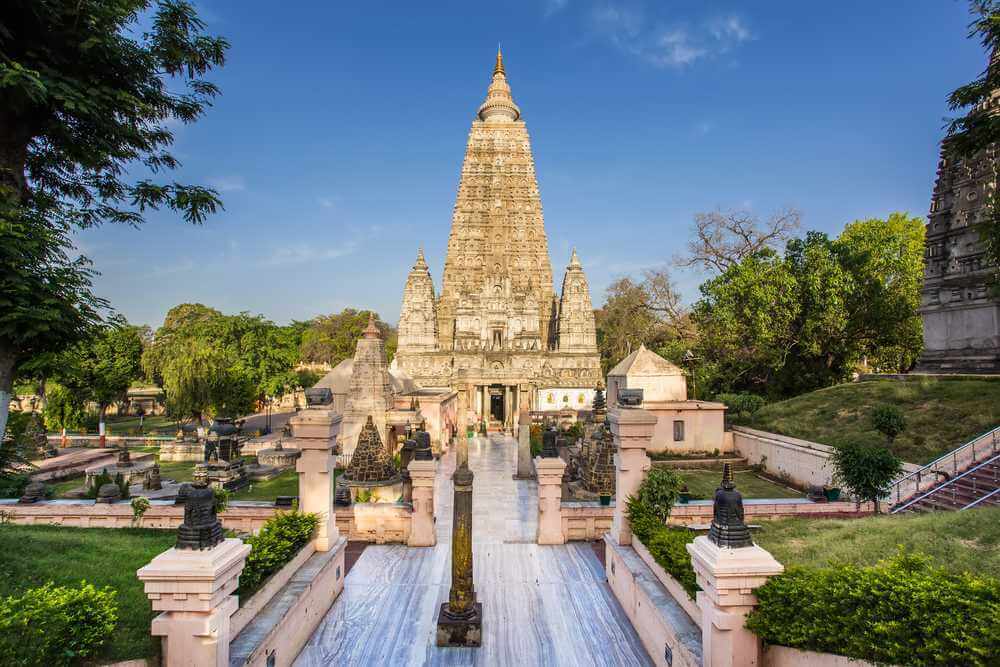
Among all the famous heritage sites in Bihar, few carry the spiritual importance of the Mahabodhi Temple Complex.
Located in Bodh Gaya, the site marks the place traditionally associated with Siddhartha Gautama attaining enlightenment and becoming the Buddha. For Buddhist pilgrims, this makes Bodh Gaya one of the most sacred destinations anywhere in the world.
UNESCO describes the complex as one of the four principal holy places associated with the life of Buddha. The first temple at the site was constructed under Emperor Ashoka in the 3rd century BCE, while much of the present temple is associated with the 5th and 6th centuries CE. It is also one of India’s earliest surviving major Buddhist temples constructed primarily from brick.
For practical planning, travelers can read the Bodh Gaya travel guide and the guide on how to reach Bodh Gaya.
Why Is the Mahabodhi Temple a UNESCO World Heritage Site?
The importance of Mahabodhi extends far beyond its architecture.
It represents the place where one of the world’s most influential philosophical and religious traditions reached its defining moment. Buddhism later spread throughout India and across Sri Lanka, Nepal, Tibet, China, Korea, Japan, Myanmar, Thailand, Cambodia and many other parts of Asia.
UNESCO inscribed the Mahabodhi Temple Complex in 2002 under five cultural criteria, reflecting its architectural importance, historical significance and direct association with Buddha’s enlightenment.
Today, travelers from many countries gather here to meditate, chant, study and simply sit quietly beneath the trees surrounding the temple.
Even visitors with no religious background often find the atmosphere unusually peaceful.
The Mahabodhi Temple
The main temple dominates the complex with its distinctive pyramidal tower rising approximately 50 meters above the surrounding sacred area.
Its brick construction is particularly important because relatively few structures from this early period have survived in such recognizable form.
The exterior contains niches, decorative motifs and images of Buddha, while the interior sanctuary contains a seated image of Buddha in the earth-touching posture known as Bhumisparsha Mudra.
This gesture recalls the moment when Buddha called the earth to witness his enlightenment.
Early morning is an especially memorable time to visit. Monks may be chanting, pilgrims circumambulate the temple and the first sunlight gradually reaches the brick tower.
The Sacred Bodhi Tree
Behind the main temple stands perhaps the most emotionally significant feature of Bodh Gaya: the Bodhi Tree.
The existing tree is traditionally regarded as a descendant of the original tree beneath which Siddhartha Gautama meditated before attaining enlightenment.
Pilgrims from around the world sit beneath and around it in meditation.
You may hear Tibetan mantras, Pali chanting, quiet conversations among monks and the fluttering of prayer texts. Travelers frequently spend far longer here than they originally planned.
The attraction is not simply the physical tree. It is the continuity of human devotion around the site that makes the experience powerful.
Vajrasana, the Diamond Throne
Close to the Bodhi Tree is the Vajrasana, or Diamond Throne.
The polished sandstone platform is traditionally associated with the place where Buddha sat during meditation. UNESCO records that Emperor Ashoka installed the Vajrasana to mark the sacred location.
It is among the most important elements within the entire temple complex.
The Seven Weeks After Enlightenment
One of the most interesting ways to explore Mahabodhi is to follow the locations traditionally associated with Buddha’s first seven weeks after enlightenment.
Different areas around the temple complex commemorate periods of meditation, contemplation and walking.
These include the Animeshlochan Chaitya and Ratnachakrama, along with the Lotus Pond and other sacred locations.
Instead of simply photographing the main temple and leaving, take time to walk through these quieter corners.
Understanding the sequence of events makes the complex much more meaningful.
Votive Stupas
Hundreds of smaller stupas surround parts of the Mahabodhi Temple.
They vary considerably in shape, age and detail. Some were offered by rulers, monks or pilgrims as expressions of devotion.
Together, these structures show how Bodh Gaya developed through centuries of pilgrimage.
Spend time looking closely at the carvings rather than seeing the stupas merely as a backdrop to the temple.
What Makes Bodh Gaya Particularly Interesting?
Unlike many ancient archaeological sites, Bodh Gaya is not simply a monument to a vanished civilization.
It remains a functioning spiritual destination.
Monks from Thailand may be praying beside pilgrims from Sri Lanka. Tibetan visitors may perform prostrations while travelers from Europe sit quietly in meditation. Buddhist communities from Bhutan, Myanmar, Japan, Vietnam and other countries maintain monasteries throughout the town.
This international atmosphere reflects the enormous geographical influence of Buddhism.
Visiting Bodh Gaya therefore provides two experiences simultaneously: an encounter with ancient history and an introduction to living Buddhist culture.
Other Places to Visit in Bodh Gaya
After exploring the UNESCO World Heritage complex, allow time for several nearby attractions:
Great Buddha Statue
The enormous seated Buddha is one of Bodh Gaya’s most recognizable modern landmarks.
Thai Monastery
This monastery displays architectural influences associated with Thailand and offers another perspective on international Buddhist traditions.
Tibetan Monasteries
Bodh Gaya has several Tibetan Buddhist institutions where visitors can observe distinctive prayer traditions, art and architecture.
Indosan Nippon Japanese Temple
The Japanese temple presents Buddhist architecture and artwork in a noticeably different style from the Indian Mahabodhi complex.
Archaeological Museum
Travelers interested in sculpture and archaeological history can visit the museum near the temple area.
Dungeshwari Cave Temples
Located outside Bodh Gaya, these caves are traditionally associated with Siddhartha Gautama’s period of severe ascetic practice before he adopted the Middle Way.
For more ideas, travelers can explore Tusk Travel’s Bihar travel guide and related Bihar tour packages.
2. Archaeological Site of Nalanda Mahavihara
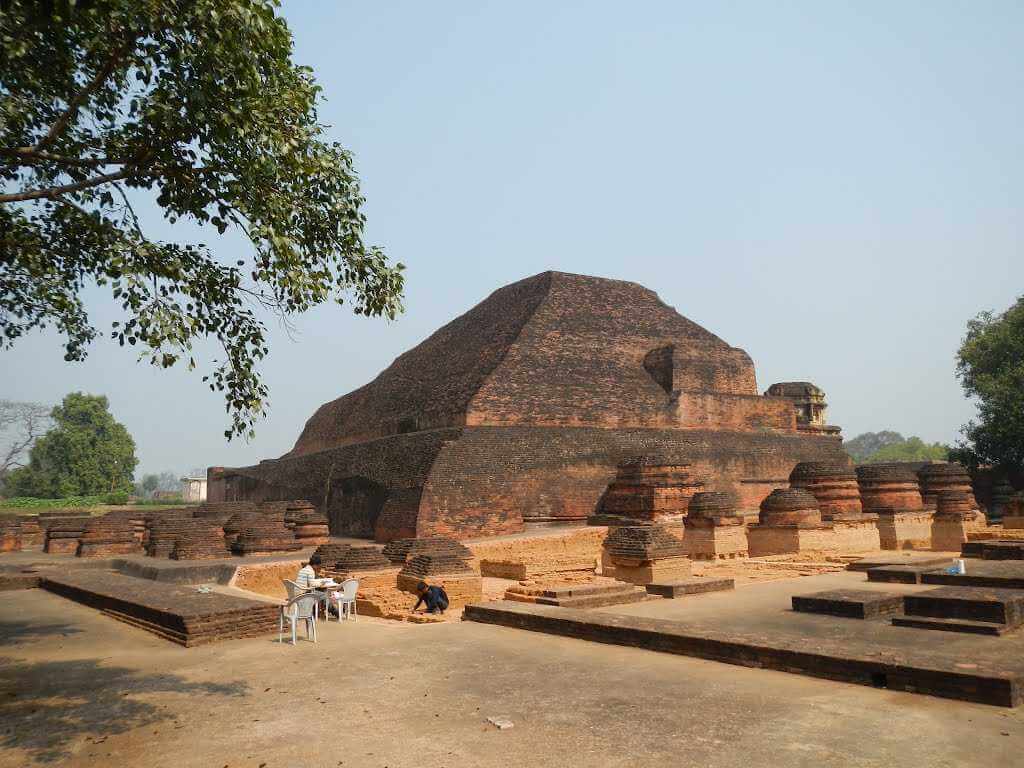
Around 80 km from Bodh Gaya lies another of the most fascinating UNESCO World Heritage Sites in Bihar: Nalanda Mahavihara.
At first glance, Nalanda is very different from Bodh Gaya.
Instead of a towering functioning temple filled with pilgrims, visitors encounter a sprawling archaeological landscape of red-brick monasteries, stupas, temples, courtyards, stairways and monastic cells.
But once you understand what happened here, the ruins become extraordinary.
Nalanda was one of the ancient world’s great centers of learning.
For additional planning information, see Tusk Travel’s guide to the best attractions in and around Nalanda.
UNESCO describes the archaeological property as containing the remains of a monastic and scholastic institution spanning approximately the 3rd century BCE to the 13th century CE. The surviving complex includes monasteries, shrines, stupas and works of art in materials such as stone, stucco and metal.
Nalanda was inscribed as a UNESCO World Heritage Site in 2016.
Why Was Nalanda So Important?
Nalanda was much more than a collection of monasteries.
It developed into a sophisticated residential center of scholarship where teachers, monks and students studied religious and secular disciplines.
Its intellectual reputation reached well beyond India.
Scholars travelled across Asia to study and exchange ideas here. Chinese Buddhist pilgrims and scholars such as Xuanzang became closely associated with Nalanda, helping preserve valuable descriptions of the institution and its academic life.
Subjects studied in the wider Nalanda tradition included Buddhist philosophy, logic, grammar, medicine, astronomy and other branches of knowledge.
UNESCO highlights Nalanda’s importance in the organized transmission of knowledge over centuries and its influence on later monastic and educational institutions elsewhere in Asia.
Walking Through the Ancient University
One of the pleasures of visiting Nalanda is that the ruins reveal the institution’s physical organization.
You can walk beside rows of monastic structures and look into former courtyards and individual cells.
Imagine scholars arriving from distant regions after journeys that might have taken months.
There were no aircraft, trains or modern roads connecting the great centers of Asia. Yet knowledge moved across extraordinary distances.
Nalanda became one of the places where this exchange occurred.
The Viharas
The monasteries, known as viharas, are among the most interesting surviving structures.
They generally followed organized plans with rooms arranged around courtyards.
These cells provided living and study spaces for monks and students.
Standing inside one of these courtyards helps visitors appreciate that Nalanda was not merely a ceremonial religious complex. It supported an active residential academic community.
Temples and Stupas
Opposite several monastic structures stand temple remains and stupas.
The repeated construction and enlargement of religious structures provide evidence of Nalanda’s long development.
Some buildings were built over earlier foundations, creating archaeological layers that help historians understand how architecture evolved through different periods.
The large stupa associated with Sariputra is particularly impressive.
Terraces, stairs and votive stupas create one of the most visually striking sections of the archaeological complex.
Architecture That Influenced Asia
Nalanda is valuable not simply because it was old.
Its architecture helped establish forms that influenced later Buddhist educational and monastic complexes.
UNESCO notes the significance of Nalanda’s planning and architectural development and its relationship to later institutions across the Indian subcontinent and wider South and Southeast Asia.
This makes Nalanda especially interesting for travelers interested in architecture.
The seemingly simple brick ruins were once part of a highly organized environment combining accommodation, religious spaces, teaching facilities and communal areas.
Nalanda Archaeological Museum
Do not leave Nalanda immediately after visiting the excavated ruins.
The archaeological museum nearby helps complete the story.
Objects recovered during excavations include sculptures, inscriptions and other antiquities representing the Buddhist, Hindu and artistic traditions connected with the region.
Seeing objects after walking through the ruins makes it easier to imagine how richly decorated the ancient complex once was.
Xuanzang Memorial Hall
Another useful stop is the memorial dedicated to the Chinese Buddhist monk and scholar Xuanzang.
He travelled from China to India during the 7th century and spent time studying at Nalanda.
His journey later became enormously important to historians because his records contain valuable descriptions of India, Buddhist institutions and society during the period.
The memorial provides international context to Nalanda’s history.
The university was not isolated. It participated in a network connecting India with other intellectual and Buddhist centers across Asia.
Bodh Gaya vs Nalanda: Which UNESCO Site Should You Visit?
Choosing between them is unnecessary if you have enough time because the two destinations complement each other perfectly.
| Experience | Bodh Gaya | Nalanda |
| Main significance | Buddha’s enlightenment | Ancient Buddhist learning |
| UNESCO inscription | 2002 | 2016 |
| Experience | Living pilgrimage site | Archaeological ruins |
| Main highlight | Mahabodhi Temple & Bodhi Tree | Monasteries, stupas & temples |
| Best for | Spirituality, Buddhism, architecture | History, archaeology, education |
| Suggested visit | Half to full day | 2 to 4 hours |
Bodh Gaya feels alive with devotion.
Nalanda encourages imagination.
Visiting both allows you to understand two major dimensions of Bihar’s Buddhist heritage: the spiritual origins of Buddhism and the intellectual traditions that later developed around it.
For travelers who prefer a ready-made route, Tusk Travel’s 3 Days Bodhgaya, Rajgir and Nalanda tour combines both UNESCO sites with Rajgir.
Important Heritage Places to Visit With Bihar’s UNESCO Sites
Bihar’s UNESCO journey becomes even more interesting when combined with several nearby historical destinations.
These places are not currently UNESCO World Heritage Sites, but they are among the state’s most important cultural attractions.
Rajgir
Rajgir is one of the best additions to a Bodh Gaya and Nalanda itinerary.
The ancient city was associated with the Magadha kingdom and has deep connections with both Buddhism and Jainism.
Important attractions include:
- Griddhakuta or Vulture’s Peak
- Vishwa Shanti Stupa
- Venu Vana
- Ancient ruins
- Hot springs
- Rajgir Ropeway
Rajgir’s hills create a dramatic contrast to Nalanda’s open archaeological landscape.
Travelers can easily combine Rajgir and Nalanda on the same day, although staying overnight nearby allows for a more relaxed experience.
Vaishali
Vaishali occupies an important place in Buddhist and Jain traditions.
It is associated with several events in Buddha’s life and also with Mahavira, the 24th Tirthankara of Jainism.
The Ashokan pillar is among the most recognizable remains in the area.
Travelers particularly interested in India’s Buddhist circuit can include Vaishali while travelling north from Patna.
Pawapuri
Pawapuri is one of Jainism’s most sacred pilgrimage destinations.
Its beautiful Jal Mandir appears to float in the middle of a lotus-filled water body.
Because Pawapuri is relatively close to Nalanda and Rajgir, it can be incorporated into a wider heritage circuit.
Kesaria Stupa
Kesaria is known for its enormous Buddhist stupa.
Although it is less frequently visited than Bodh Gaya or Nalanda, it provides another reminder of the scale of Bihar’s Buddhist archaeological heritage.
Vikramshila
Travelers interested in ancient education should also know about Vikramshila.
Established centuries after Nalanda had already become famous, Vikramshila developed into another important Buddhist monastic and academic center.
The archaeological site lies near Antichak in the Bhagalpur region.
It requires additional travel time, so it is better suited to deeper Bihar itineraries rather than quick Bodh Gaya-Nalanda trips.
Travelers planning a longer route can browse Tusk Travel’s Bihar tour packages for additional itinerary ideas.
Best Time to Visit UNESCO World Heritage Sites in Bihar:
The most comfortable period for a heritage trip through Bihar is generally October to March.
Temperatures are more suitable for walking through archaeological complexes and outdoor attractions during these months. Tusk Travel’s Bihar travel guide also provides broader information about seasonal travel, transport and sightseeing.
October to November
Conditions become increasingly pleasant after the monsoon.
The landscape may still appear green, making this a good period for photography.
December to February
These are excellent months for sightseeing.
Mornings can be cool, especially in December and January, but daytime exploration is generally comfortable.
Bodh Gaya also attracts large numbers of international Buddhist pilgrims during the cooler months.
March
March can still work well, particularly during the first half of the month, although temperatures begin increasing.
April to June
Summer can become extremely hot.
Nalanda requires considerable outdoor walking, so midday sightseeing can be uncomfortable.
July to September
Monsoon rains may interrupt outdoor sightseeing, although the countryside becomes greener and tourist numbers may be lower.
How Many Days Do You Need for Bihar’s UNESCO Heritage Circuit?
A 3-day itinerary is sufficient for the core Bodh Gaya, Rajgir and Nalanda circuit.
Day 1: Bodh Gaya
Visit:
- Mahabodhi Temple
- Bodhi Tree
- Great Buddha Statue
- International monasteries
- Local market
Stay overnight in Bodh Gaya.
Day 2: Bodh Gaya to Rajgir
Travel to Rajgir and explore:
- Griddhakuta
- Vishwa Shanti Stupa
- Venu Vana
- Selected historical attractions
Stay in Rajgir or continue toward Nalanda/Bodh Gaya depending on your itinerary.
Day 3: Nalanda
Explore:
- Nalanda Mahavihara archaeological ruins
- Nalanda Archaeological Museum
- Xuanzang Memorial Hall
Continue to Patna or return toward Bodh Gaya.
Travelers can also consider Tusk Travel’s 3 Days Bodhgaya, Rajgir and Nalanda itinerary, which connects both UNESCO properties with Rajgir in a compact heritage route.
How to Reach Bihar’s UNESCO Sites:
Reaching Bodh Gaya
Gaya is the most convenient gateway for Bodh Gaya.
Gaya International Airport is located near the pilgrimage town, while Gaya Junction is a major railway station with connections to several Indian cities.
Tusk Travel’s detailed Bodh Gaya travel guidance explains the available air, rail and road connections for visitors.
Reaching Nalanda
Nalanda is usually reached by road from Patna, Rajgir or Bodh Gaya.
Patna is the principal gateway for travelers arriving from many major Indian cities.
For most visitors, hiring a private vehicle for Bodh Gaya, Rajgir and Nalanda is convenient because it makes it easier to stop at smaller historical attractions along the route.
Travel Tips for Visiting Bihar’s Heritage Sites:
Start Early
Both Bodh Gaya and Nalanda are more enjoyable in the morning, particularly during warmer months.
Give Bodh Gaya Enough Time
Do not treat Mahabodhi as a quick photo stop. Sit quietly near the Bodhi Tree and observe the rituals around the complex.
Hire a Knowledgeable Guide at Nalanda
Without historical context, Nalanda can appear to be a collection of brick foundations.
A knowledgeable guide can explain how the monasteries, temples and academic spaces functioned.
Wear Comfortable Shoes
Nalanda requires substantial walking.
The same applies if you climb or walk through attractions around Rajgir.
Respect Religious Practices
Mahabodhi is an active pilgrimage destination rather than simply an archaeological monument.
Keep conversations quiet around meditation areas and follow local instructions regarding photography, footwear and restricted items.
Allow Time Between Destinations
Distances on a map can sometimes look shorter than the actual road journey.
Avoid packing too many archaeological and pilgrimage sites into a single day.
Why Bihar Deserves More Attention From Heritage Travelers
- Bihar is sometimes overlooked by travelers who focus on Rajasthan’s forts, Agra’s Mughal architecture or South India’s great temple cities.
- Yet few places in India can equal Bihar’s historical influence.
- Bodh Gaya preserves the landscape connected with an event that transformed religious history across Asia.
- Nalanda tells another story, one about teachers, students, monasteries and international intellectual exchange.
- Rajgir connects visitors with the early history of Magadha and Buddha’s teachings.
- Vaishali adds Buddhist, Jain and ancient political significance.
- Pawapuri introduces one of Jainism’s most sacred sites.
- Seen together, these destinations reveal Bihar not as a collection of isolated monuments but as a cultural landscape where ideas developed, travelled and influenced communities thousands of kilometers away.
That is precisely what makes exploring the UNESCO World Heritage Sites of Bihar so rewarding.
Frequently Asked Questions:
1. How many UNESCO World Heritage Sites are there in Bihar?
Bihar currently has two UNESCO World Heritage Sites: the Mahabodhi Temple Complex at Bodh Gaya and the Archaeological Site of Nalanda Mahavihara at Nalanda.
2. Which was the first UNESCO World Heritage Site in Bihar?
The Mahabodhi Temple Complex at Bodh Gaya was Bihar’s first property to be inscribed on the UNESCO World Heritage List. It was added in 2002.
3. Is Nalanda University a UNESCO World Heritage Site?
The UNESCO-listed property is officially known as the Archaeological Site of Nalanda Mahavihara at Nalanda, Bihar. It was inscribed on the World Heritage List in 2016.
4. Is Bodh Gaya a UNESCO World Heritage Site?
The Mahabodhi Temple Complex at Bodh Gaya is a UNESCO World Heritage Site. It marks the location traditionally associated with Buddha attaining enlightenment.
5. Is Rajgir a UNESCO World Heritage Site?
No. Rajgir is an extremely important historical and religious destination, but it is not currently an inscribed UNESCO World Heritage Site. It is, however, one of the best places to combine with Nalanda and Bodh Gaya.
6. Can Bodh Gaya, Rajgir and Nalanda be covered in one trip?
Yes. They form one of Bihar’s most convenient heritage circuits. A two-night, three-day itinerary can cover the principal attractions, although four days provides a more relaxed experience.
7. What is the best time to explore Bihar’s UNESCO heritage sites?
October through March generally offers the most comfortable weather for archaeological sightseeing, temple visits and outdoor exploration.
Final Thoughts
The UNESCO World Heritage Sites in Bihar tell two remarkable stories.
At Bodh Gaya, visitors stand in a place connected with Buddha’s enlightenment, an event whose influence travelled across much of Asia and continues to shape spiritual traditions today.
At Nalanda, visitors walk through the remains of an institution where generations of monks and scholars pursued knowledge and exchanged ideas with travelers from distant lands.
These sites are not merely monuments preserved from the past.
They represent Bihar’s contribution to global religion, philosophy, education, architecture and cultural exchange.
Combine them with Rajgir, Pawapuri, Vaishali or other historical destinations and a Bihar trip becomes much more than sightseeing. It becomes a journey through some of the most important chapters in the intellectual and spiritual history of India.
For travelers who enjoy archaeology, Buddhism, ancient history and meaningful cultural experiences, Bihar deserves a prominent place on the India travel map.
