
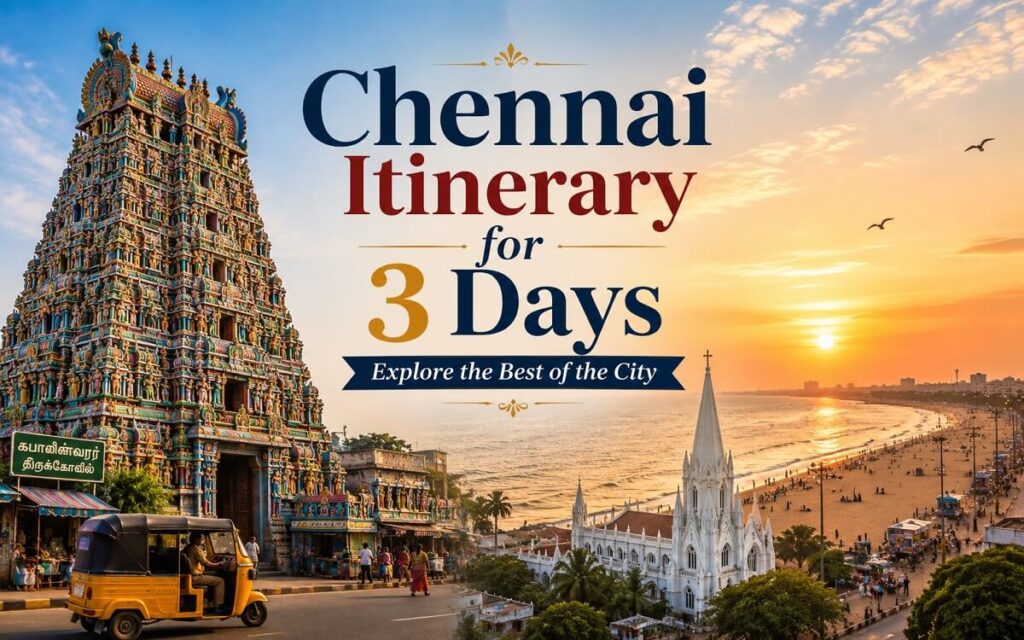
Chennai is one of those cities that reveals itself gradually. At first glance, you may notice busy roads, modern neighborhoods, and the warm breeze coming from the Bay of Bengal. Spend a little more time here, however, and you begin to discover colorful Dravidian temples, colonial buildings, centuries-old neighborhoods, lively markets, excellent South Indian food, classical music traditions, and long stretches of coastline.
Formerly known as Madras, Chennai is the capital of Tamil Nadu and an important cultural gateway to South India. It is a particularly rewarding destination for travelers who want to understand Tamil culture before continuing to temple towns such as Kanchipuram, Mahabalipuram, Thanjavur, Madurai, or Rameswaram.
If you have three days in the city, you have enough time to experience its major historical, religious, cultural, and coastal highlights without turning your holiday into a race between attractions. Tusk Travel also considers two to three days a practical amount of time for exploring Chennai’s principal sights.
This 3-day Chennai itinerary has been designed for first-time visitors who want a balanced introduction to the city. Instead of simply listing attractions, it groups places geographically so that you spend more time exploring and less time sitting in traffic.
For a longer journey through the state, browse these Tamil Nadu tour packages. Travelers who want a private or customized city experience can also explore the Chennai tour packages.
Chennai 3-Day Itinerary at a Glance
Day 1: Traditional Chennai and the Coast
Kapaleeshwarar Temple → Mylapore → San Thome Basilica → Marina Beach
Your first day introduces you to Chennai’s spiritual traditions, historic neighborhoods, religious diversity, and famous coastline.
Day 2: Colonial Chennai, Museums and Local Markets
Fort St. George → St. Mary’s Church → Government Museum → George Town or T. Nagar
Day two focuses on Chennai’s colonial history, art collections, local commerce, and city life.
Day 3: South Chennai, Culture and Beaches
Besant Nagar → Ashtalakshmi Temple → Elliot’s Beach → cultural experiences and shopping
Your final day is intentionally more relaxed, combining local neighborhoods, coastal scenery, food, and time for shopping or cultural activities.
Day 1: Temples, Mylapore, San Thome and Marina Beach
Start your Chennai trip with the part of the city that best represents its traditional character.
Morning: Visit Kapaleeshwarar Temple
Begin early in Mylapore, one of Chennai’s most culturally significant neighborhoods.
At the heart of the area stands Kapaleeshwarar Temple, dedicated to Lord Shiva. Its colorful gopuram covered with sculpted figures immediately introduces visitors to the distinctive architecture of Tamil Nadu.
The temple is not simply a historical monument. It remains an active place of worship, so visiting it gives you an opportunity to observe everyday religious life rather than just admire architecture.
Spend time walking around the temple complex, noticing the shrines, pillars, sculptures, lamps, flower sellers, and devotees bringing offerings.
Dress modestly when visiting. Shoes must normally be removed before entering the main temple premises, and certain inner religious areas may have access restrictions.
Even travelers who are not particularly interested in religion should consider including Kapaleeshwarar Temple in their Chennai 3-day itinerary because it provides valuable context for the many temples they may encounter elsewhere in Tamil Nadu.
Explore the Streets of Mylapore
Do not leave immediately after visiting the temple.
Walk around the surrounding Mylapore streets, where traditional businesses stand alongside cafés, jewelry stores, flower vendors, religious shops, and small restaurants.
This is one of the best areas in Chennai for observing everyday Tamil life.
Depending on your interests, you can stop for a traditional breakfast of:
- Idli with sambar and chutney
- Masala dosa
- Pongal
- Medu vada
- Poori
- South Indian filter coffee
Breakfast is taken seriously in Chennai, and a crisp dosa with freshly prepared chutney can easily become one of the memorable meals of your trip.
Late Morning: San Thome Basilica
From Mylapore, continue toward San Thome Basilica.
The church provides a striking contrast to the Dravidian temple you visited earlier in the morning. Its neo-Gothic appearance reflects another important layer of Chennai’s religious and colonial history.
San Thome Basilica is traditionally associated with the tomb of St. Thomas the Apostle and remains an important Christian pilgrimage site. The Mylapore area is notable precisely because places associated with different religious traditions exist relatively close to one another.
Spend approximately 45 minutes to an hour here.
Whether you visit for religious reasons or simply appreciate historical buildings, the quieter atmosphere provides a pleasant break from Chennai’s busy streets.
Lunch: Try a Traditional Tamil Meal
By lunchtime, look for a traditional South Indian restaurant.
One excellent experience is a Tamil-style meal served with rice and several accompaniments. Depending on the restaurant, a meal may include sambar, rasam, vegetable preparations, curd, pickles, papad, and sweets.
Both vegetarian and non-vegetarian food is easy to find in Chennai.
If you prefer something lighter, another dosa or an idiyappam-based meal can work well, particularly when the weather is hot.
Afternoon: Marina Beach and Chennai’s Coastal Side
After lunch and some rest, head toward Marina Beach, Chennai’s most famous waterfront.
The beach runs along the Bay of Bengal and is deeply woven into everyday city life. Early mornings and evenings are generally the most atmospheric times to experience the promenade because local families, walkers, food vendors, and visitors gather along the coast.
Rather than approaching Marina Beach as a conventional resort beach, experience it as a public space.
Walk along the promenade, watch local life unfold, feel the coastal breeze, and observe the statues and landmarks lining the beachfront.
The wider Marina district also provides easy access to several prominent government buildings and educational institutions.
Evening: Watch the Sunset Atmosphere
Stay until early evening.
Sunset and the period immediately afterward bring a different energy to the beach. Street vendors sell snacks, families gather near the waterfront, and the temperature becomes more comfortable.
Popular local snacks may include roasted corn, sundal made with chickpeas, bajji, and fresh fruit.
Swimming is not the main reason to visit Marina Beach, and sea conditions can be unpredictable. Treat it primarily as a sightseeing and walking experience.
Afterward, return to your hotel for dinner.
Day 1 Route
Hotel → Kapaleeshwarar Temple → Mylapore → San Thome Basilica → Lunch → Marina Beach → Hotel
Your first day covers Chennai’s spiritual character, historic neighborhoods, local cuisine, and coastline without excessive travel between distant parts of the city.
Day 2: Fort St. George, Museums, Markets and City Life
Day two of your 3-day Chennai trip focuses more heavily on history.
Chennai played an important role in British colonial expansion in South India, and several buildings still reflect that period.
Morning: Fort St. George
Begin your day at Fort St. George.
Established during the 17th century, the fort became a major center of the East India Company’s activities in southern India. Parts of the complex are now associated with the Tamil Nadu government, while the historic fort area preserves reminders of colonial Madras.
The architecture is quite different from the massive defensive forts you might see in Rajasthan or central India. Fort St. George is better understood as a fortified colonial administrative complex.
Its historical significance is greater than its dramatic appearance.
Visit the Fort Museum
If accessible during your visit, explore the Fort Museum.
Its collections help explain Chennai’s colonial period through objects connected with the East India Company and British administration.
Travelers interested in history will especially appreciate seeing old coins, military objects, portraits, documents, uniforms, and other artifacts associated with colonial Madras.
Allow around one hour.
St. Mary’s Church
Within the Fort St. George complex, look for St. Mary’s Church, dating from the 17th century.
The church is an important surviving colonial-era structure and offers another window into the early European history of Chennai.
Compared with some of Chennai’s colorful temples, its appearance is restrained and relatively simple, making the architectural contrast even more interesting.
Optional Stop: George Town
From the fort area, consider exploring George Town, particularly if you enjoy markets and street photography.
This historic commercial district is very different from polished modern shopping malls.
Expect narrow streets, traffic, wholesalers, old shopfronts, religious buildings, street vendors, and an energetic atmosphere.
It is best experienced with patience rather than a strict checklist.
Walk through selected streets, observe how different businesses cluster together, and stop occasionally for tea or snacks.
George Town can feel chaotic to first-time visitors, but that is part of its character. Travelers wanting a more comfortable experience may explore it with a local guide rather than navigating independently.
Lunch
After your morning sightseeing, stop for lunch before continuing to the museum district.
Chennai offers everything from traditional vegetarian restaurants to modern cafés and refined South Indian dining.
If you eat non-vegetarian food, you might try Chettinad-style dishes known for aromatic spices. Seafood is another natural choice in this coastal city.
Afternoon: Government Museum, Chennai
Continue to the Government Museum in Egmore.
For travelers interested in history, archaeology, sculpture, and South Indian art, this is one of the most worthwhile attractions in Chennai.
The museum complex includes collections spanning archaeology, art, anthropology, numismatics, and natural history.
One of its particular strengths is South Indian bronze sculpture.
You do not necessarily need to examine every gallery. Two hours is usually sufficient for a first visit if you concentrate on the collections that interest you most.
Museum visits also make good afternoon activities because Chennai can become hot and humid outdoors during the middle of the day.
Late Afternoon: Choose T. Nagar or Relax at Your Hotel
After the museum, choose between shopping and a short rest.
Option 1: T. Nagar
For shopping, travel to T. Nagar, one of Chennai’s busiest commercial areas.
The neighborhood is particularly associated with silk sarees, jewelry, textiles, clothing, and traditional shopping.
Visitors planning to buy a Kanchipuram silk saree may find plenty of choice here, although prices and quality vary considerably.
Even without shopping, T. Nagar offers an energetic glimpse into modern Chennai.
Option 2: Relax Before Dinner
If you prefer a slower holiday, return to your hotel for an hour or two.
Three days in Chennai should feel enjoyable rather than exhausting.
Evening: Experience Chennai’s Food Culture
Make your second evening about food.
Try a different side of Tamil cuisine instead of repeating your first day’s meal.
Possible dishes include:
- Appam with vegetable or meat stew
- Kothu parotta
- Chettinad chicken
- Fish curry
- Podi dosa
- Idiyappam
- Parotta with kurma
- Curd rice
- Payasam
- Filter coffee
Chennai also has a growing café and contemporary restaurant scene, so travelers do not need to eat traditional meals at every opportunity.
Day 2 Route
Hotel → Fort St. George → St. Mary’s Church → George Town → Lunch → Government Museum → T. Nagar → Dinner
By the end of the second day, you will have seen both historic Madras and contemporary Chennai.
Day 3: Besant Nagar, Temples, Culture and a Relaxed Chennai Experience
Your final day should not be another marathon of monuments.
Instead, spend time in South Chennai, enjoy the coast again, and choose cultural experiences based on your interests.
Morning: Explore Besant Nagar
Begin around Besant Nagar, one of the city’s more relaxed seaside neighborhoods.
The area feels noticeably different from the dense lanes of Mylapore or the commercial activity of central Chennai.
Its cafés, residential streets, religious sites, and beach make it a pleasant place to spend a slower morning.
Visit Ashtalakshmi Temple
Near the coast is Ashtalakshmi Temple, dedicated to different manifestations of Goddess Lakshmi.
The temple’s location near the Bay of Bengal adds to the atmosphere.
As with other Hindu religious sites, dress conservatively, remove footwear where required, and follow instructions regarding photography.
Even if you visited Kapaleeshwarar Temple on your first day, the experience here feels different enough to justify another temple stop.
Walk Along Elliot’s Beach
After the temple, continue to Elliot’s Beach, also commonly associated with Besant Nagar.
Compared with Marina Beach, it generally feels smaller and more neighborhood-oriented.
Take a slow walk along the waterfront and stop for coffee, juice, or breakfast if you did not eat earlier.
If you enjoy photography, mornings can provide softer light and fewer crowds.
Midday: Discover Chennai’s Artistic Side
Chennai is closely associated with Carnatic music and Bharatanatyam, two traditions that play a major role in South Indian cultural life.
If performances, workshops, exhibitions, or cultural programs coincide with your visit, consider adding one to your third day.
The city becomes particularly active culturally during the December music season, when performances take place at venues across Chennai.
Even outside festival periods, travelers interested in classical arts can often find cultural institutions and performances worth exploring.
Because event schedules change, check locally once your travel dates are confirmed.
Alternative: Visit a Craft and Heritage Centre
Travelers especially interested in architecture, craft traditions, and rural culture may use part of the third day to explore one of Chennai’s cultural institutions rather than adding another city monument.
This is particularly worthwhile if Chennai is the first stop on a longer Tamil Nadu itinerary, because it can help you understand the traditional homes, crafts, religious practices, and artistic traditions you will encounter elsewhere.
Lunch: Have One Last South Indian Feast
For your final Chennai lunch, consider choosing a well-regarded Tamil restaurant and ordering a more complete meal.
If you have eaten mostly vegetarian food during your trip, try regional seafood or Chettinad cuisine. If you prefer vegetarian meals, Chennai offers enormous variety beyond the standard dosa and idli.
Try dishes you may not easily find outside southern India.
Ask restaurant staff for local recommendations rather than ordering only familiar foods.
Afternoon: Shopping for Souvenirs
Reserve your final afternoon for shopping.
Good Chennai souvenirs include:
Kanchipuram Silk
Tamil Nadu is internationally known for its silk weaving traditions, and Chennai has numerous stores selling Kanchipuram sarees.
If authenticity matters, purchase from an established seller.
Traditional Jewelry
Temple-style jewelry and gold jewelry are closely connected with South Indian aesthetics and classical dance traditions.
Handicrafts
Look for carved wooden objects, bronze figures, traditional lamps, decorative items, and handmade products.
Spices and Food Products
Coffee, spice blends, sweets, pickles, and packaged South Indian snacks can make practical gifts.
Books and Music
Travelers interested in Tamil history, classical dance, Carnatic music, or Indian spirituality may find specialty bookshops particularly rewarding.
Evening: Finish Your Trip by the Sea
Your final evening in Chennai is best kept simple.
Return to Elliot’s Beach or another convenient coastal area, find a café, and enjoy the sea breeze.
After three days of temples, colonial landmarks, museums, markets, cuisine, and neighborhood walks, the slower evening gives you time to absorb the experience.
Chennai’s appeal is not based on a single extraordinary monument. Its strength lies in the combination of living traditions, religious diversity, food, music, architecture, neighborhoods, and coastal life.
That combination becomes much clearer after spending several days here.
Best Time to Visit Chennai
The most comfortable period for sightseeing is generally November through February, when temperatures are relatively milder.
Chennai remains warm for much of the year, and March through early summer can be particularly hot and humid. During hotter months, begin sightseeing early, take a midday break, and schedule outdoor attractions toward late afternoon.
Rain is also possible during the region’s monsoon periods, so keep some flexibility in your schedule.
For temple visits and walking tours, early morning is often the most pleasant time regardless of season.
How to Get Around Chennai:
Chennai is a large metropolitan city, so transport planning makes a significant difference to your trip.
Private Car with Driver
For visitors spending only three days in Chennai, a private vehicle is often the most convenient choice.
It reduces the time spent arranging transportation between attractions and is particularly useful in hot weather.
Metro
Chennai’s metro system can be useful for selected journeys, particularly between major areas connected by the network.
Auto Rickshaws
Auto rickshaws are readily available for shorter distances. Confirm the fare or use an app-based option where appropriate.
App-Based Taxis
Ride-hailing services can be convenient for independent travelers, although waiting times can vary during peak periods.
Traffic can become heavy, so avoid creating a sightseeing plan with attractions scattered randomly across the city.
This itinerary intentionally groups nearby areas together.
Where to Stay in Chennai for 3 Days:
Your ideal neighborhood depends on what you want from the trip.
Mylapore
A good option for travelers primarily interested in culture, temples, and traditional neighborhoods.
T. Nagar
Convenient for shopping, restaurants, and access to central areas.
Nungambakkam
Popular for hotels, restaurants, cafés, and relatively central positioning.
Egmore
Useful for travelers who want access to railway connections and central historic attractions.
Besant Nagar
Suitable for travelers who prefer a quieter coastal atmosphere and do not mind staying farther from some central attractions.
Choose your hotel based on sightseeing priorities rather than simply selecting the cheapest property, because Chennai’s size and traffic can significantly affect daily travel time.
What to Eat During Your Chennai Trip
Food deserves its own place in any Chennai travel itinerary.
Do not leave the city without trying several of these:
- Idli
- Dosa
- Medu vada
- Pongal
- Sambar
- Rasam
- Appam
- Idiyappam
- Kothu parotta
- Chettinad dishes
- South Indian thali
- Curd rice
- Filter coffee
- Payasam
Vegetarian travelers will find Chennai particularly easy to explore.
At the same time, the city’s seafood and meat-based Tamil cuisines deserve attention from non-vegetarian visitors.
Practical Tips for a 3-Day Chennai Trip
Start early. Temperatures are more comfortable and many religious areas are particularly atmospheric in the morning.
Dress respectfully for temples. Clothing covering shoulders and knees is a sensible choice.
Carry water. Chennai’s warm, humid climate can be tiring if you are not accustomed to it.
Do not schedule too many attractions. Traffic and heat can turn an ambitious itinerary into an exhausting one.
Allow time for food. Local cuisine is part of the Chennai experience, not merely a break between attractions.
Keep footwear practical. You will remove your shoes at temples, so comfortable footwear that is easy to take on and off is useful.
Check attraction schedules before departure. Museums, churches, temples, and heritage sites can have varying opening periods, religious observances, holidays, or temporary restrictions.
Respect photography rules. Some temple interiors and religious areas restrict cameras.
Can You Explore Chennai in 3 Days?
Yes.
Three days is a very practical amount of time for a first visit to Chennai.
You will not see every museum, neighborhood, market, temple, and cultural institution, but you can experience the city’s essential character without rushing.
A well-planned 3-day Chennai itinerary gives you enough time for:
- Major temples
- Colonial landmarks
- Museums
- Marina Beach
- Mylapore
- San Thome Basilica
- Local markets
- South Indian cuisine
- Shopping
- A second coastal neighborhood
- Cultural experiences
Travelers with additional time can extend their journey beyond Chennai to Mahabalipuram, Kanchipuram, Pondicherry, Tirupati, or deeper into Tamil Nadu.
Chennai works particularly well as the starting point for a longer South India tour. Tusk Travel’s Tamil Nadu itineraries, for example, commonly connect Chennai with destinations such as Mahabalipuram, Pondicherry, Thanjavur, Madurai, Rameswaram, and other southern destinations.
Suggested Extensions After Chennai:
1. Mahabalipuram
Mahabalipuram is one of the most popular additions to a Chennai trip. Its rock-cut monuments, Shore Temple, Five Rathas, and other Pallava-era sites make it particularly attractive to travelers interested in architecture and history.
2. Kanchipuram
Known for important temples and silk weaving, Kanchipuram is another rewarding extension.
3. Pondicherry
Pondicherry offers a very different atmosphere with its colonial heritage, seaside promenade, cafés, spiritual associations, and French-influenced streets.
4. Madurai
Travel farther south to experience the magnificent Meenakshi Amman Temple and one of Tamil Nadu’s most important historic cities.
For customized routes combining these destinations, explore Tamil Nadu tours or browse dedicated Chennai tours.
Frequently Asked Questions About a 3-Day Chennai Trip
1. Are 3 days enough for Chennai?
Yes. Three days are enough to see Chennai’s major highlights, including Mylapore, Kapaleeshwarar Temple, San Thome Basilica, Marina Beach, Fort St. George, Government Museum, shopping areas, and South Chennai’s coastal neighborhoods.
2. What is the best 3-day Chennai itinerary for first-time visitors?
Spend day one exploring Mylapore, Kapaleeshwarar Temple, San Thome Basilica, and Marina Beach. Use day two for Fort St. George, Government Museum, historic markets, and shopping. Spend day three around Besant Nagar, Elliot’s Beach, cultural attractions, local food, and souvenir shopping.
3. Which area is best to stay in Chennai?
Mylapore, T. Nagar, Nungambakkam, Egmore, and Besant Nagar are all useful options. Choose according to whether you prioritize heritage attractions, shopping, transport, restaurants, or beach access.
4. What is Chennai famous for?
Chennai is known for Dravidian temples, Marina Beach, Carnatic music, Bharatanatyam, Tamil cuisine, colonial history, silk shopping, and its role as a gateway to South India.
5. What should I wear while sightseeing in Chennai?
Light cotton clothing is generally comfortable in Chennai’s warm climate. Carry modest clothing for temples and religious sites, ideally covering shoulders and knees.
6. Is Chennai good for international tourists?
Yes. Chennai is one of India’s major metropolitan cities and is particularly useful as an arrival point for travelers exploring Tamil Nadu and South India. Its combination of heritage, food, religious sites, beaches, and transport connections makes it a good introduction to the region.
7. Where can I travel after spending three days in Chennai?
Mahabalipuram and Kanchipuram are natural nearby additions, while Pondicherry, Thanjavur, Madurai, Rameswaram, and other Tamil Nadu destinations can be included in longer itineraries.
Worth Reading:
- How to Reach Chennai: Best Ways to Travel to the City
- 10 Most Popular Temples to Visit in Chennai
- 10 Best Places Near Chennai to Visit in September 2026
- 10 Amazing Places Near Chennai Within 200 km
- 7 Best Heritage and Historical Places in Chennai
- 10 Beautiful Places Near Chennai Within 100 km
- 10 Famous Pilgrimage and Religious Places Near Chennai
- 12 Popular Museums in Chennai Worth Visiting
- 15 Best Things to Do in Chennai on Your Trip
- 10 Best Weekend Places Near Chennai in April 2027
Final Thoughts
A 3-day Chennai trip offers much more than a quick introduction to another Indian metropolis.
In the space of three days, you can watch rituals unfold inside a colorful Tamil temple, walk through the traditional streets of Mylapore, visit a historic Christian pilgrimage site, study centuries of South Indian art, explore colonial-era Madras, browse busy shopping streets, taste authentic Tamil cuisine, and end your evenings beside the Bay of Bengal.
The key is not trying to see everything.
Chennai rewards travelers who allow time to observe everyday life between the major attractions. Have filter coffee instead of rushing to your next monument. Walk around Mylapore after visiting its temple. Spend an evening watching families gather beside the sea. Try a dish you have never heard of. Talk to a local guide about Tamil customs and traditions.
Those experiences transform a simple sightseeing schedule into a genuine introduction to Chennai.
If Chennai is only the beginning of your South India journey, consider extending your holiday through Tamil Nadu’s temple towns, heritage sites, beaches, hill stations, and cultural centers. Browse Tamil Nadu tour packages for longer travel ideas, or explore Chennai tour options if you would prefer a private, customized sightseeing experience.
With three thoughtfully planned days, Chennai can become much more than a gateway. It can be one of the most memorable stops on your journey through South India.
