
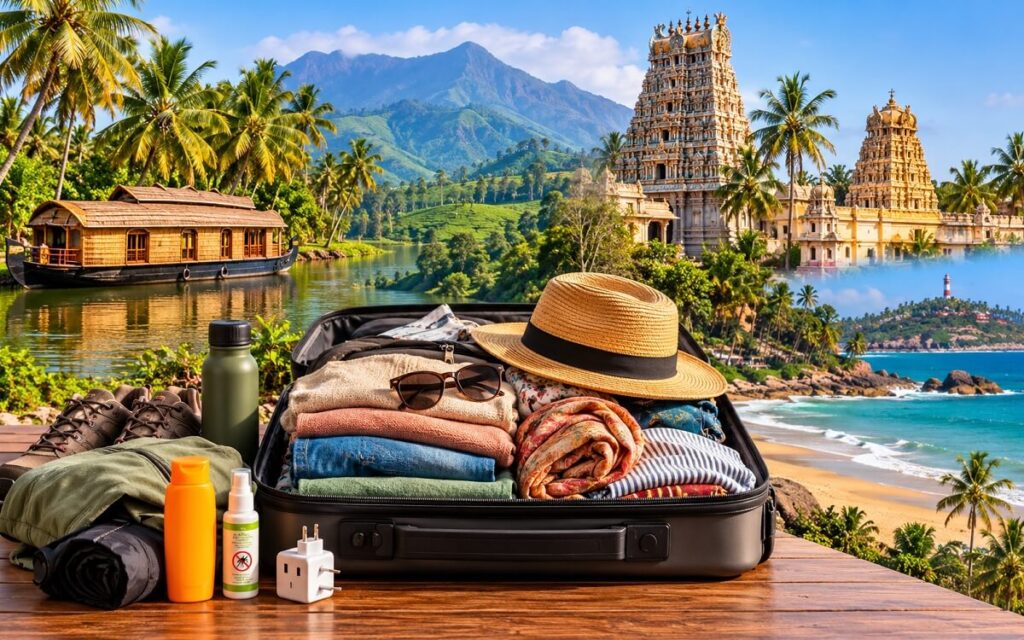
Packing for South India in winter can be surprisingly confusing.
You may be travelling in December or January, yet Kochi can still feel warm and tropical. A few days later, however, an early morning in Munnar or Ooty may be cool enough for a fleece or light jacket.
Therefore, the most important rule is simple: do not pack for South India as though it has one winter climate.
Kerala’s backwaters, Tamil Nadu’s temple cities, Karnataka’s hill stations and Goa’s beaches can feel very different during the same trip.
For a broader overview of suitable fabrics, modest clothing and regional dress, see our guide to what to wear in India.
For most South India journeys between November and February, lightweight breathable clothes should form the majority of your suitcase. However, add one or two warm layers if your itinerary includes Munnar, Ooty, Kodaikanal, Coorg, Wayanad or other hill regions.
This South India winter packing list explains exactly what to wear, what shoes to bring, what you need for temples, and which items are worth carrying for beaches, backwaters and hill stations.
What to Pack for a South India Trip in Winter
For a typical winter journey through South India, start with this simple checklist:
- 4–6 lightweight tops or shirts
- 2–3 pairs of breathable trousers
- 1 comfortable long skirt or dress if preferred
- 1 lightweight sweater or cardigan
- 1 fleece or light jacket for hill stations
- 1 scarf, shawl or stole
- comfortable walking shoes
- easy-to-remove sandals
- sleepwear
- underwear and socks
- swimwear if visiting beaches or resorts
- lightweight rain layer or compact umbrella
- hat or cap
- sunglasses
- sunscreen
- insect repellent
- reusable water bottle
- small day bag
- universal power adapter
- power bank
- regular medicines and prescriptions
However, you may not need every item on this list.
Your final packing should depend on whether you are visiting the coast, temples, hill stations or all three.
Is South India Cold in Winter?
South India generally has a milder winter than North India.
Coastal Kerala, Goa and much of Tamil Nadu remain warm during the day. As a result, you will usually wear lightweight cotton or linen clothing for sightseeing.
Hill stations are different.
Places such as Munnar, Ooty, Kodaikanal and Coorg are at higher elevations. Consequently, mornings and evenings can feel considerably cooler.
You may experience three different conditions on the same holiday:
Coast and backwaters: warm and sometimes humid
Temple cities and plains: warm days with more comfortable evenings
Hill stations: cool mornings and evenings, particularly in December and January
Therefore, layers work much better than packing one heavy winter coat.
What Clothes Should You Wear in South India in Winter?
For most daytime sightseeing, choose lightweight and breathable clothes.
Useful options include:
- cotton shirts
- linen shirts
- breathable T-shirts
- loose trousers
- lightweight travel pants
- long skirts
- casual dresses
- breathable blouses
Cotton and linen work particularly well because temperatures can still feel warm around midday.
At the same time, avoid packing only very short summer clothes.
Many South India itineraries include active temples and religious sites, where more modest clothing is appropriate.
A wardrobe that can work for both sightseeing and temple visits will save considerable suitcase space.
What to Wear in Kerala in December and January
Kerala is one of the most popular South India destinations during winter.
However, what you need in Kochi or Alleppey is very different from what you need in Munnar.
Kochi, Alleppey and Kumarakom
For the coast and backwaters, pack:
- lightweight cotton tops
- breathable trousers or skirts
- sandals
- sunglasses
- sunscreen
- sun hat
- light evening layer
- insect repellent
Heavy winter clothes are unnecessary for most travellers.
Even in December and January, daytime conditions can feel warm.
Munnar and the Western Ghats
For Munnar, add:
- lightweight sweater
- fleece
- light jacket
- long trousers
- closed walking shoes
- socks
Early mornings and evenings can feel cool, particularly when you are outside for viewpoints or plantation visits.
Therefore, keep your warm layer easily accessible rather than burying it at the bottom of your suitcase.
What to Pack for Munnar in Winter
Munnar is one of the destinations where travellers most often underestimate the temperature difference.
A morning viewpoint or outdoor activity can feel considerably cooler than an afternoon in Kochi.
For Munnar, pack:
- T-shirts or breathable shirts for daytime
- long trousers
- lightweight sweater
- fleece or jacket
- walking shoes
- socks
- light rain protection
- sunscreen
- hat
- small backpack
You do not usually need a heavy North India-style winter coat.
Instead, use layers that can be removed as the day warms.
For more on the tea-country climate and sightseeing conditions, see our Munnar travel guide and best time to visit Munnar.
What to Wear in Ooty During Winter
Ooty is another South India destination where winter clothing becomes more useful.
December and January mornings can feel cold, particularly if you are accustomed to tropical weather.
Pack:
- long trousers
- shirts or tops
- sweater
- fleece
- lightweight jacket
- closed shoes
- socks
- scarf or shawl
A jacket is especially useful for early starts, scenic drives and evenings.
However, daytime sunshine can still feel comfortable. Therefore, avoid packing only heavy clothes.
If Ooty is one stop on a longer winter holiday, compare the weather and destinations in our guide to the best places to visit in South India in December.
What to Pack for Coorg in Winter
Coorg generally requires a similar approach.
During the day, lightweight clothing may be comfortable. Meanwhile, mornings and evenings can be cooler.
Bring:
- breathable daytime clothes
- one sweater or fleece
- long trousers
- walking shoes
- socks
- light rain jacket
- insect repellent
If your itinerary includes plantation walks or outdoor trails, closed shoes are more practical than sandals.
What to Wear in Tamil Nadu in Winter
Tamil Nadu’s major cultural destinations remain relatively warm during much of winter.
Travellers visiting Chennai, Mahabalipuram, Thanjavur, Trichy, Madurai or Rameswaram usually do not need heavy winter clothing.
Instead, pack lightweight, modest clothing suitable for temple visits.
Useful choices include:
- cotton shirts
- breathable tops
- loose trousers
- long skirts
- lightweight dresses
- scarf or shawl
- sandals that are easy to remove
However, Tamil Nadu’s hill stations are different.
If your journey includes Ooty or Kodaikanal, add a sweater, fleece or light jacket.
What to Wear When Visiting Temples in South India
A South India itinerary often includes active Hindu temples rather than archaeological monuments.
Therefore, respectful clothing should be part of your packing plan.
In general, choose clothing that covers your shoulders and knees.
Useful items include:
- long trousers
- long skirts
- modest dresses
- shirts with sleeves
- scarf or shawl
Some temples have more specific dress requirements.
Therefore, check the rules for important temples on your itinerary before visiting.
In addition, footwear must usually be removed before entering temple areas.
For that reason, sandals or slip-on shoes can be very convenient.
For travellers visiting Madurai, Rameswaram and other Tamil Nadu temples as part of a wider holiday, the 12-day South India itinerary illustrates why practical temple clothing is worth packing alongside beachwear.
Best Shoes for a South India Trip:
You do not need a suitcase full of footwear.
For most travellers, two pairs are enough.
Comfortable walking shoes
Bring one pair of lightweight walking shoes for:
- city sightseeing
- heritage monuments
- hill stations
- plantation walks
- longer walking days
They should already be broken in before your trip.
Easy-to-remove sandals
A second pair of comfortable sandals is useful for:
- temples
- hotels
- beaches
- short sightseeing stops
- warm coastal destinations
Temple visits often involve removing footwear repeatedly, so complicated boots or heavily laced shoes can become inconvenient.
Do You Need a Winter Jacket in South India?
For most coastal and lowland destinations, no.
However, a light jacket or fleece is useful for hill stations.
Bring one if your itinerary includes:
- Munnar
- Ooty
- Kodaikanal
- Coorg
- Wayanad
- other elevated areas
It can also be useful on heavily air-conditioned flights, trains and vehicles.
The key word is light.
Unless your itinerary includes unusually cold high-altitude areas outside the normal South India tourist circuit, you generally do not need a bulky winter coat.
Should You Pack an Umbrella?
Yes, a small umbrella can still be useful.
Winter in South India is usually more comfortable than the main monsoon period. Nevertheless, local rain is still possible.
Tamil Nadu, in particular, can receive rainfall from the northeast monsoon during part of the October–December period.
Therefore, a compact umbrella or lightweight rain jacket is worth carrying if you travel in November or December.
It also serves as useful sun protection on hot sightseeing days.
Beach Packing for Goa, Kerala and Karnataka
If your South India journey includes a beach stay, add a few beach-specific items.
Pack:
- swimwear
- beach cover-up
- flip-flops
- sunscreen
- sunglasses
- hat
- quick-dry towel if needed
- waterproof pouch
- reusable water bottle
However, avoid wearing beachwear away from the immediate beach or resort environment.
A light cover-up makes moving between your hotel, restaurant and beach easier.
What to Pack for Kerala Backwaters
An overnight houseboat stay requires very little specialised gear.
Useful items include:
- lightweight clothes
- sandals
- insect repellent
- sunscreen
- sunglasses
- hat
- small overnight bag
- light evening layer
- personal medicines
Avoid carrying your full suitcase around the houseboat if your driver or hotel can safely hold unnecessary luggage.
A smaller overnight bag makes the stay much easier.
Sun Protection Is Still Essential in Winter
The word “winter” can make travellers underestimate the sun.
South India still receives strong sunlight during December and January.
Therefore, bring:
- broad-spectrum sunscreen
- sunglasses
- hat or cap
- lightweight long sleeves
- reusable water bottle
Apply sunscreen before sightseeing rather than waiting until you feel hot.
This matters particularly at beaches, temple complexes and exposed heritage sites.
Medicines and Health Essentials
Bring enough of your regular prescription medicines for the whole trip.
Also carry a copy of your prescription where appropriate.
A small personal travel-health kit may include:
- regular medication
- basic pain relief
- plasters
- antiseptic wipes
- oral rehydration salts
- motion-sickness medication if you use it
- insect repellent
- hand sanitiser
However, avoid packing a large pharmacy of medicines you do not normally use.
If you have an ongoing medical condition, discuss travel medication with your healthcare professional before departure.
Insect Repellent and Mosquito Protection
Mosquitoes can be present even during winter, particularly around tropical, forested and waterside destinations.
Therefore, insect repellent remains useful in:
- Kerala backwaters
- Thekkady
- coastal areas
- forest regions
- tropical resorts
Long lightweight trousers and sleeves can also provide additional protection in the evening.
Electronics to Pack for South India
Most travellers need only a few essentials.
Bring:
- phone
- charger
- universal travel adapter
- power bank
- camera if required
- spare memory card
- headphones
India commonly uses plug types C, D and M.
Therefore, international travellers should carry a reliable universal adapter.
Keep power banks in your cabin baggage when flying, in accordance with airline rules.
Important Documents to Carry
Keep your essential travel documents organised and easy to access.
International visitors should carry:
- passport
- valid Indian visa or relevant travel authorisation
- travel insurance information
- flight details
- hotel confirmations
- emergency contact information
- copies of important documents
Keeping encrypted digital copies can also be useful.
However, do not rely entirely on your phone because batteries, internet access and devices can fail.
What to Carry in Your Day Bag
Your sightseeing bag should be small and light.
Carry only what you are likely to use during the day:
- water bottle
- sunglasses
- sunscreen
- hat
- phone
- power bank
- tissues
- hand sanitiser
- small amount of cash
- essential medication
- scarf or shawl
- light rain protection when needed
A heavy day bag becomes tiring quickly, particularly on temple and heritage days involving a lot of walking.
How Much Clothing Do You Need for 10 Days?
Travellers often pack far more clothes than they actually use.
For a typical 10-day South India itinerary, consider approximately:
- 5 lightweight tops
- 3 pairs of trousers
- 1 long skirt or dress if preferred
- 1 sweater
- 1 fleece or light jacket if visiting hills
- 1 scarf or shawl
- 1 set of sleepwear
- underwear and socks
- 1 pair walking shoes
- 1 pair sandals
- swimwear if needed
Laundry is available at many hotels.
Therefore, travelling with a smaller suitcase is usually easier than packing a fresh outfit for every day.
Packing for a Two-Week South India Tour
Even for a 14-day holiday, you do not need twice as many clothes.
Instead, pack enough for roughly one week and use hotel laundry services.
For example:
- 5–6 tops
- 3–4 bottoms
- 1 casual dress or extra outfit
- 1 sweater
- 1 lightweight jacket
- 1 scarf
- 2 pairs of footwear
- underwear for roughly one week
This is particularly useful on multi-city trips because you may change hotels frequently.
A smaller suitcase makes every transfer easier.
What Not to Pack for South India
A good packing list is also about knowing what to leave at home.
For most winter trips, you probably do not need:
- heavy winter coat
- several pairs of jeans
- multiple formal outfits
- numerous pairs of shoes
- expensive jewellery
- excessive toiletries
- large quantities of packaged food
- bulky towels
- too many electronic devices
Likewise, cutlery is generally unnecessary for ordinary travellers.
Restaurants and hotels serving tourists will provide appropriate utensils, while eating selected foods by hand is simply part of the local dining experience.
Pack for convenience rather than trying to prepare for every possible situation.
Packing by South India Destination:
A quick destination-based approach makes packing easier.
Kerala Coast and Backwaters
Pack mostly lightweight clothing, sandals, sun protection and insect repellent.
Munnar
Add a sweater, fleece or light jacket.
Tamil Nadu Temple Circuit
Prioritise lightweight modest clothing and easy-to-remove footwear.
Ooty and Kodaikanal
Add warm layers, closed shoes and socks.
Coorg and Wayanad
Bring light layers, walking shoes and rain protection.
Goa and Gokarna
Add beachwear, sandals, swimwear and extra sun protection.
Hampi
Bring comfortable walking shoes, a hat, sunscreen and breathable clothes because sightseeing can involve considerable outdoor walking.
Packing for November in South India
November is a transition month across parts of the region.
Kerala usually becomes more comfortable after the main southwest monsoon. Meanwhile, Tamil Nadu may still receive rain associated with the northeast monsoon.
Therefore, pack:
- lightweight clothes
- compact umbrella
- light rain jacket
- comfortable shoes
- sun protection
- one warm layer for hill stations
If you are visiting Kerala in November, lightweight tropical clothing should still make up most of your suitcase.
Before packing, compare local conditions and experiences in our guide to the best places to visit in Kerala in November.
Packing for December in South India
December is one of the most popular months to visit South India.
Coastal areas remain warm, while hill stations become cooler.
Therefore, use a combination of:
- lightweight daytime clothes
- long trousers
- sandals
- walking shoes
- scarf or shawl
- light sweater
- fleece or jacket for hills
You still need sunscreen.
Winter sunshine can remain strong even when temperatures feel pleasant.
Packing for January in South India
January follows a similar pattern, although some hill areas can feel particularly cool in the morning.
If your itinerary includes Kerala’s coast and Tamil Nadu’s plains, breathable clothing remains suitable for most days.
However, add layers for:
- Munnar
- Ooty
- Kodaikanal
- Coorg
- Wayanad
Do not assume that the entire South India trip requires winter clothing simply because one or two destinations are cold.
A Practical Packing List for a Classic South India Tour
Consider a route such as:
Chennai → Mahabalipuram → Pondicherry → Madurai → Munnar → Thekkady → Alleppey → Kochi
For the Tamil Nadu section, you mainly need lightweight, modest clothing.
Afterwards, Munnar requires an extra warm layer.
Thekkady may also feel cooler in the morning, while Alleppey and Kochi return you to warmer tropical conditions.
This is exactly why layering works better than carrying a heavy jacket.
For an example of this mix of warm plains, cooler hills and backwaters, see our 10-day South India tour itinerary.
What to Wear on Travel Days
South India road journeys can involve several hours in an air-conditioned vehicle.
Therefore, travel in:
- comfortable trousers
- breathable top
- light layer
- easy shoes
Keep your sweater or shawl inside the vehicle rather than packed in the luggage compartment.
Air conditioning can feel surprisingly cold after spending time outside.
Temple, Hill Station and Beach in One Trip
Many South India itineraries combine completely different environments.
For example, you may visit Madurai’s temples, Munnar’s tea-covered hills and Kerala’s backwaters within a few days.
You do not need three separate wardrobes.
Instead, pack versatile pieces:
- lightweight long trousers
- breathable tops
- large scarf
- sandals
- walking shoes
- light fleece
These items can be combined differently according to the destination.
Frequently Asked Questions About Packing for South India:
What should I pack for South India in winter?
Pack mostly lightweight, breathable clothes, comfortable walking shoes, sandals, sun protection and a scarf. Add a sweater or light jacket if your itinerary includes hill stations such as Munnar, Ooty, Kodaikanal or Coorg.
Do I need winter clothes in South India?
Not for most coastal and lowland destinations. However, hill stations can become cool in the morning and evening, so one warm layer is useful.
What should I wear in Kerala in December?
Lightweight cotton or linen clothes work well around Kochi, Alleppey and the coast. However, add a sweater, fleece or light jacket if you are visiting Munnar.
Do I need a jacket in Munnar in December?
A light jacket or fleece is recommended, particularly for early mornings and evenings. A heavy winter coat is usually unnecessary for ordinary sightseeing.
What should I wear in South Indian temples?
Wear modest clothing that generally covers your shoulders and knees. Some temples have specific dress requirements, so check the rules before visiting.
What shoes are best for South India?
Bring comfortable walking shoes and easy-to-remove sandals. The sandals are especially convenient at temples, where footwear is frequently removed.
Should I carry an umbrella in December?
A compact umbrella can still be useful, particularly in parts of Tamil Nadu where seasonal rain may continue. It can also provide sun protection.
What should I pack for Ooty in December?
Bring long trousers, a sweater or fleece, a light jacket, closed shoes and socks in addition to your normal lightweight clothing.
Can I wear shorts in South India?
Shorts are fine in many resorts, beach areas and casual settings. However, longer clothing is more appropriate for temples, religious sites and some traditional communities.
How much luggage should I bring for a two-week South India trip?
A medium suitcase or manageable travel bag is usually sufficient. Pack roughly one week’s worth of clothing and use laundry services instead of carrying 14 completely different outfits.
Final South India Winter Packing Checklist:
Before closing your suitcase, check that you have:
Clothing
- lightweight shirts and tops
- breathable trousers
- modest temple outfit
- sweater or cardigan
- fleece or light jacket for hills
- scarf or shawl
- sleepwear
- underwear and socks
- swimwear where needed
Footwear
- walking shoes
- comfortable sandals
- flip-flops if needed
Weather Essentials
- sunscreen
- sunglasses
- hat
- compact umbrella
- lightweight rain protection
- insect repellent
Travel Essentials
- passport and visa
- travel insurance details
- phone and charger
- universal adapter
- power bank
- reusable water bottle
- regular medicines
- small day bag
Final Thoughts
The best South India winter packing list is not the one with the most items. It is the one that matches your actual route.
For Kerala’s coast, Tamil Nadu’s temple cities and Goa’s beaches, lightweight clothing should dominate your suitcase.
However, add a sweater, fleece or light jacket if you are travelling into the Western Ghats or Nilgiri Hills.
Most importantly, pack layers rather than bulky winter clothing.
That approach allows the same suitcase to work in warm Kochi, cool Munnar, temple-filled Madurai and breezy Alleppey without carrying unnecessary weight.
South India in winter is one of the easiest regions of India to pack for once you understand one simple fact: the coast stays warm, while the hills can become genuinely cool.
If you are still planning your route, browse our South India tour packages to see which climates and experiences your holiday will include.
