
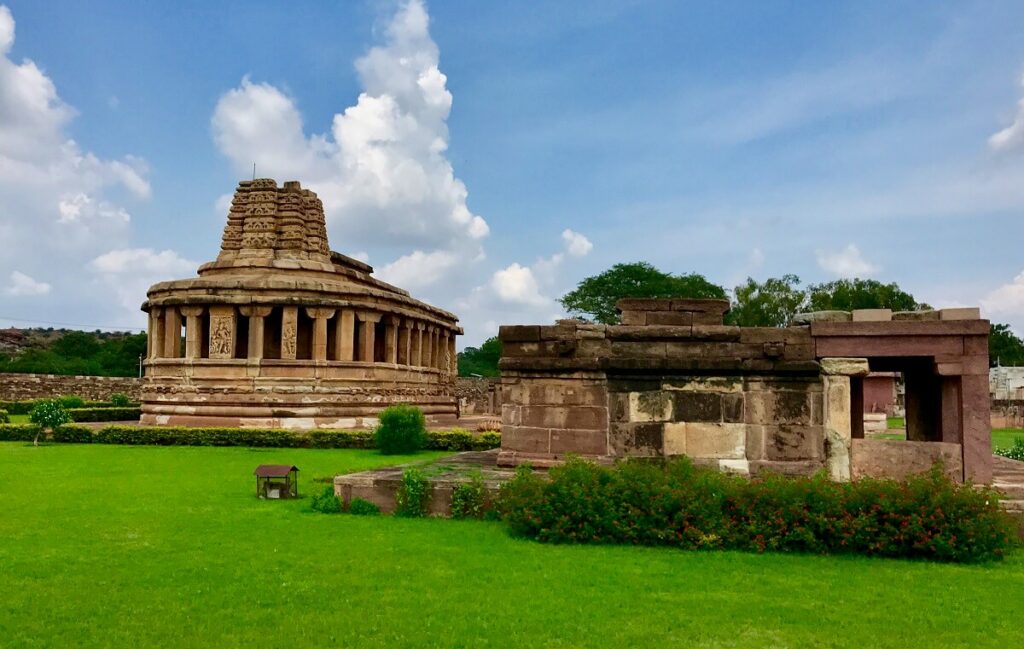
On the banks of the Malaprabha River in Karnataka’s Bagalkot district, Aihole is more than just a village—it is a living museum of early Indian temple architecture. Often referred to as the “cradle of Indian temple architecture,” this historic site flourished under the Early Chalukyas between the 6th and 8th centuries. Here, architects experimented with forms, layouts, and decorative styles that would later be perfected in nearby Pattadakal and Badami.
Today, Aihole boasts over a hundred stone and cave temples spread across a compact area, allowing visitors to witness the evolution of temple design in just a day or two of exploration. From grand apsidal structures to intimate village shrines, each monument tells its own chapter in the story of Indian architecture.
For travelers, Aihole is not just an academic site—it is a quiet, atmospheric place where history sits in the open air, accessible at a human scale. You can walk from one temple to another, observe the changing details in pillars, towers, and sanctums, and understand how religious, cultural, and artistic influences shaped these spaces. Visiting Aihole is like leafing through an ancient design notebook, where every page reveals a fresh idea.
The 10 Temples in Aihole You Must See:
1. Durga Temple
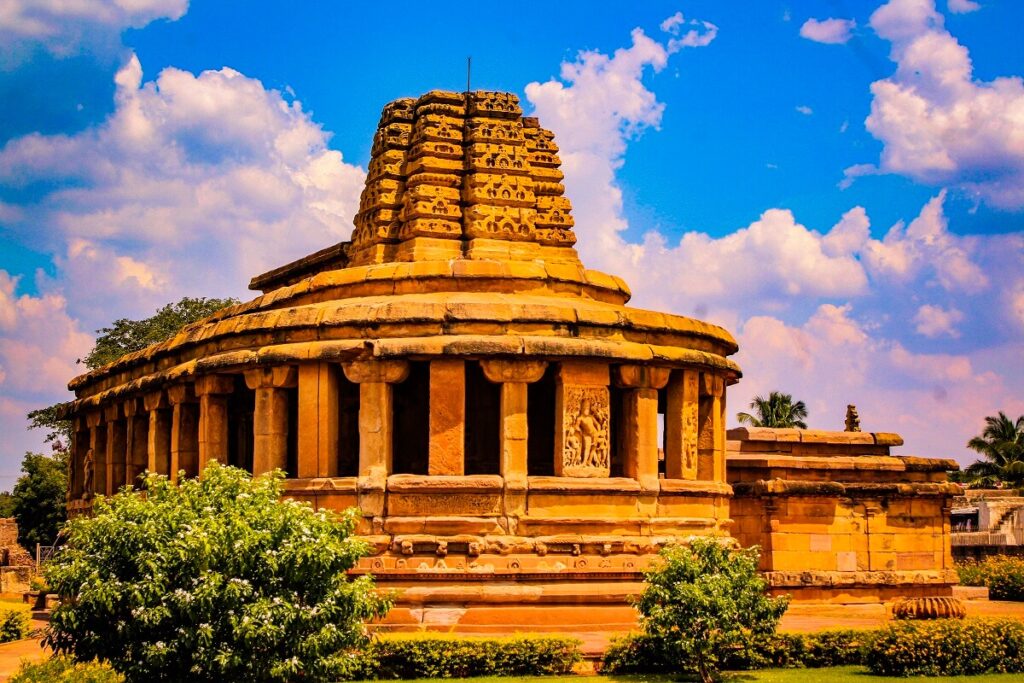
The Durga Temple is the crown jewel of Aihole and the most photographed monument in the village. Its unusual apsidal plan, resembling a horseshoe, is a rare feature in Hindu temple architecture, reminiscent of earlier Buddhist chaitya halls.
Built on an elevated platform with a continuous pillared corridor for circumambulation, the temple combines Dravida and Nagara architectural influences. Intricate carvings of deities and guardians line the circumambulatory path, making it a fascinating site to study both structure and sculpture. Read More: Durga Temple Aihole – History, Entry Timings & Tips
Why it’s famous: Prototype vibes; its apsidal plan is unusual among Hindu temples.
Allow: 45–60 minutes for the temple + grounds.
Access: Within the ticketed Durga Temple complex, which also houses the ASI museum.
2. Lad Khan Temple
A short walk from the Durga Temple is the Lad Khan Temple, one of the earliest surviving examples of structural temple architecture in Aihole. It looks almost like a simple pillared house, with a flat roof and open hall, hinting at the domestic origins of early shrine design.
The temple’s interior houses Shaiva and Vaishnava motifs, reflecting the religious inclusivity of the Chalukyan period. Its modesty is deceptive—it represents an important stage in the evolution from wooden and brick structures to stone-built temples.
Why it’s famous: Among Aihole’s earliest experiments in mandapa forms and roof treatments.
Tip: Look for the unusual ceiling treatments and the “house-like” profile that sets it apart from later towered shrines.
3. Ravana Phadi Cave Temple
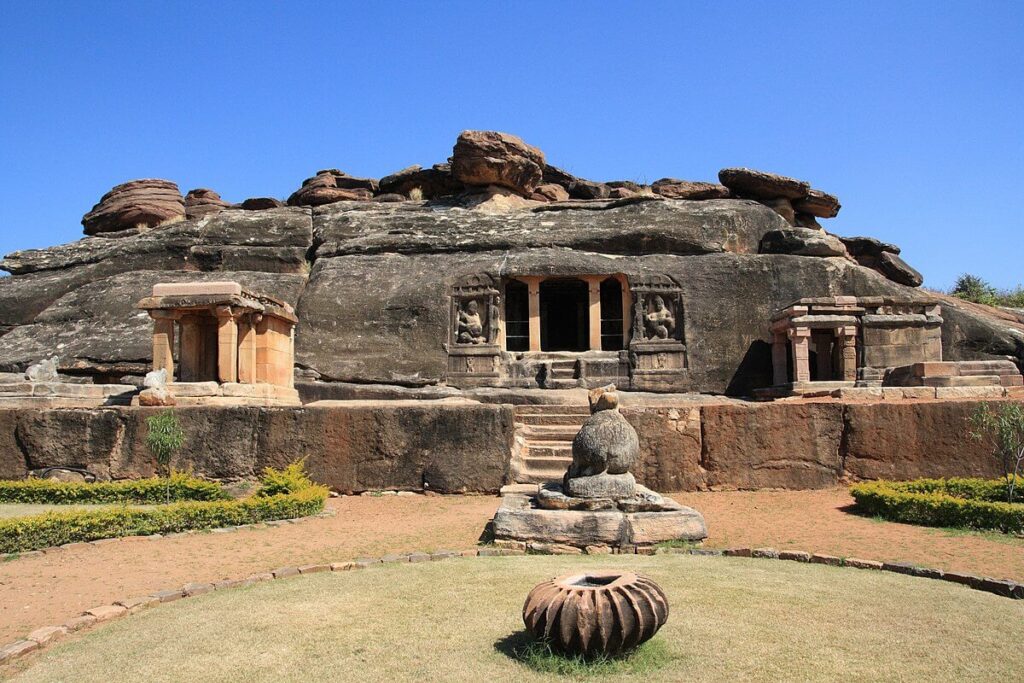
The Ravana Phadi Cave Temple offers a completely different experience. Carved directly into the sandstone hillside, this 6th-century cave shrine is dedicated to Lord Shiva and contains some of Aihole’s most expressive stone reliefs.
The highlight is a large depiction of Nataraja, Shiva as the cosmic dancer. The dim light and rock-cut interiors create a meditative atmosphere, and visiting this cave underscores the transition from rock-cut sanctuaries to free-standing stone temples.
Why it’s famous: One of the oldest cave shrines in the region, with powerful Shaiva imagery.
Photo tip: Bring a phone torch to study details without using flash on carvings.
4. Huchimalli Temple
Huchimalli Temple stands out for its prominent tower (shikhara) and elevated plinth. The temple’s rekhanagara-style shikhara is a prime example of early curvilinear tower design.
Its walls are punctuated with niches containing finely carved figures, while the entranceway is adorned with intricate ornamentation. This temple provides a clear view of how sculptural detail and tower design were integrated into early Dravida-Nagara hybrids.
Why it’s famous: Clear, textbook Dravida–Nagara interplay with a confident tower silhouette.
5. Huchappayya Gudi
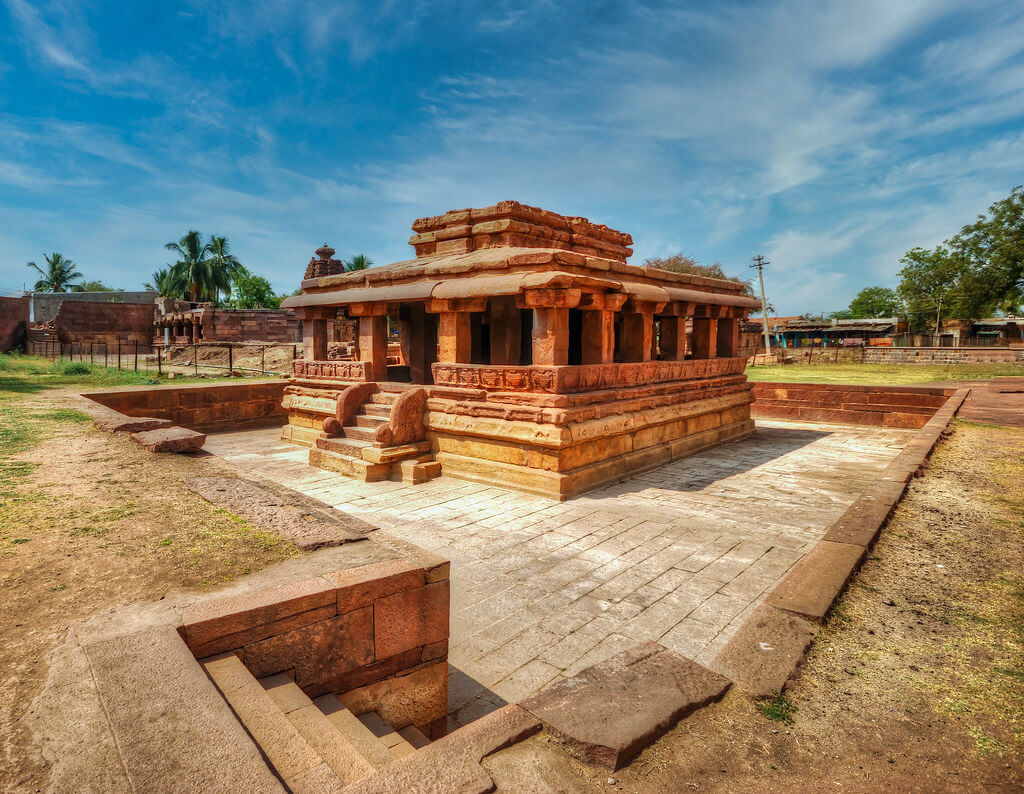
Located closer to the river, Huchappayya Gudi is known for its four-faced Shiva lingam, a symbolic representation of Shiva’s omnipresence. The temple’s carvings include notable panels of Nataraja and other Shaiva imagery. It is smaller and quieter than some of the other sites, offering visitors a peaceful atmosphere for contemplation.
Why it’s famous: Fine interior carvings (look for Nataraja) and a shrine layout that rewards a slow circuit.
6. Meguti Jain Temple
Perched on a hill overlooking the village, the Meguti Jain Temple is an important monument for understanding Jain heritage in the region. Built of finely cut stone blocks, the temple is dedicated to a Jain Tirthankara and is accompanied by inscriptions that provide valuable historical information.
The climb to the top is rewarded with panoramic views of Aihole’s temples and surrounding countryside, making it an ideal spot for photography and orientation.
Why it’s famous: An early Jain monument with inscriptions and a commanding setting that helps you map the whole site in your head.
Allow: 30–40 minutes including the short hike.
7. Ambiger Gudi Complex
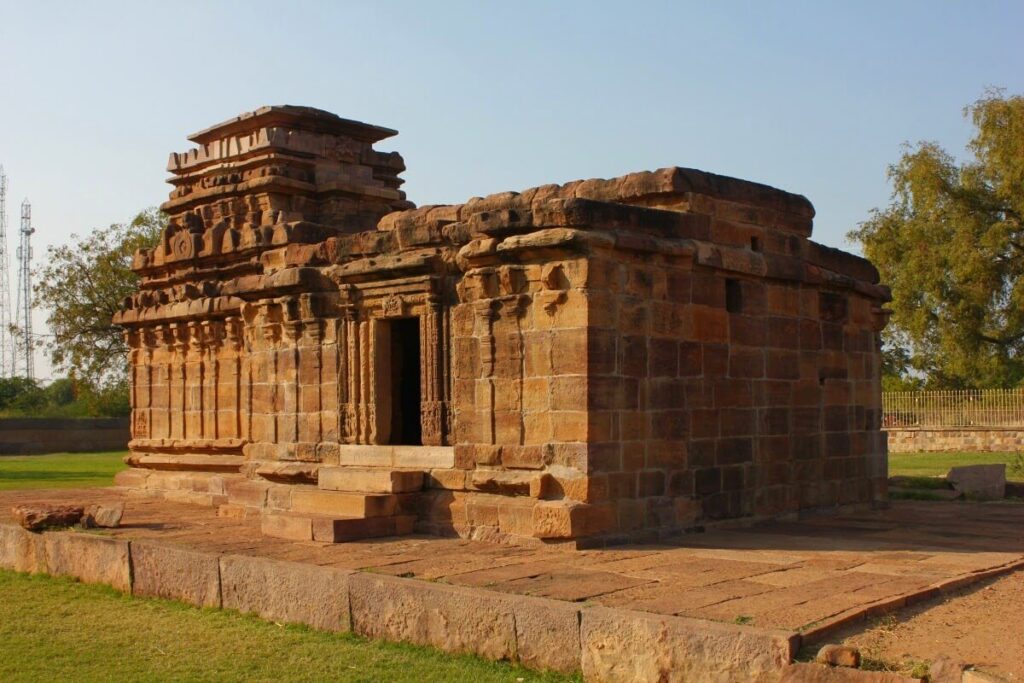
This small cluster of shrines illustrates how different temple layouts could coexist within the same precinct. The Ambiger Gudi temples feature varied pillar designs, base mouldings, and plan types. For architecture enthusiasts, this site offers a condensed lesson in spatial organization and proportional harmony.
Why it’s famous: A small lab of proportions and plan-types—perfect for first-time architecture enthusiasts.
8. Galaganatha Group
Situated near the riverbank, the Galaganatha Group of temples focuses primarily on Shaiva worship. The shrines here have elegant shikharas and decorative niches, and the setting by the water enhances their visual appeal. Visiting in the late afternoon allows you to enjoy the warm light reflecting off the sandstone.
Why it’s famous: A serene setting and a collection that shows Shaiva iconographic consistency across shrines.
9. Mallikarjuna Group
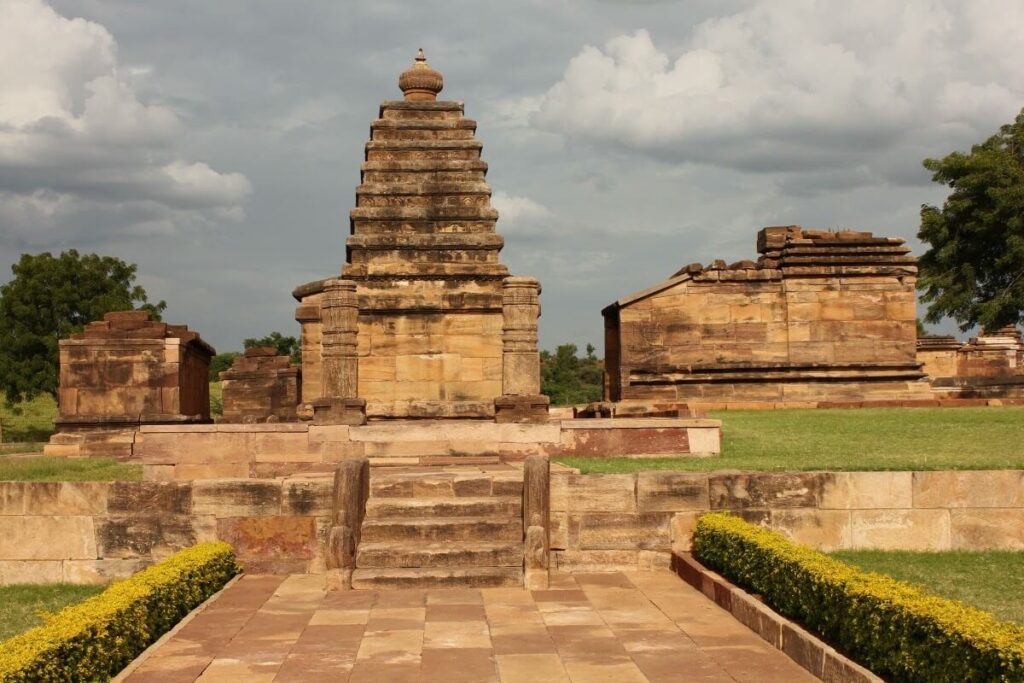
The Mallikarjuna temples are a good study in the relationship between porch, hall, and sanctum. Their proportions, base mouldings, and overall balance show that even smaller temples were carefully designed to achieve a sense of harmony. The site is less frequented, allowing for unhurried observation.
Why it’s famous: Classroom-clear lessons in plan and elevation, without the crowds.
10. Kontigudi Group
In the center of the village, the Kontigudi cluster includes four shrines. One of the most remarkable features here is the ceiling panel depicting the Trimurti—Brahma, Vishnu, and Shiva—together. The central location makes it an easy addition to any walking tour, and it provides insight into the symbolic richness of Chalukyan art.
Why it’s famous: Central location and a ceiling panel of the Trimurti—look up!
Suggested Itinerary
Morning (8:30–11:30 AM)
Start at the Durga Temple complex when the light is soft and crowds are thin. Explore Durga Temple (45–60 min), Lad Khan (20–30 min), and the ASI Archaeological Museum (30–45 min).
Late Morning (11:30 AM–1:00 PM)
Head to Ravana Phadi (30–40 min), then Huchimalli (20–30 min). Keep some water handy—little shade at midday.
Lunch break (1:00–2:00 PM)
Simple local eateries in Aihole or carry snacks and fruit. (Facilities are basic—bring a reusable bottle.)
Afternoon (2:00–5:30 PM)
Climb to Meguti Jain Temple (40 min round-trip), then loop through Ambiger Gudi, Mallikarjuna, Kontigudi, and Galaganatha (60–90 min combined). End near the river for golden-hour photos.
With two days, stretch the pace, add smaller shrines, and include nearby Pattadakal (UNESCO) and Badami Caves on separate days. Pattadakal is roughly 14 km from Aihole—an easy hop and a powerful complement.
How to Reach Aihole:
By Air (then road/rail):
The region is rural; there’s no airport at Aihole. The usual play is to fly into Hubballi (Hubli) or Belagavi (Belgaum), then continue by train or car. From Hubballi, travelers often connect to Badami or Bagalkot and proceed to Aihole by taxi. (Expect ~3–4 hours by road from Hubballi to Badami, plus ~40–60 minutes onward to Aihole.)
By Train:
The closest railheads are Badami (≈33 km) and Bagalkot (≈34 km) with regular services from Karnataka hubs. From either station, take a taxi or KSRTC bus.
By Road (self-drive or taxi):
Roads are decent; signage improves near the monuments. Typical legs:
- Badami → Aihole: ~35 km / ~1 hr
- Bagalkot → Aihole: ~34 km / ~1 hr
- Pattadakal → Aihole: ~14 km / ~20–30 min
Tips for Visitors
- Climate: Winters (October–March) are ideal; summers can be extremely hot.
- Attire: Modest clothing is recommended, and shoes must be removed at active shrines.
- Facilities: Limited in Aihole; base yourself in Badami or Bagalkot for better accommodation and dining.
- Photography: Respect “no flash” signs; a small torch helps in darker interiors.
- Guides: Hiring a local guide enriches the visit with stories and context.
Nearby Attractions
- Pattadakal: A UNESCO World Heritage site just 14 kilometers away, showcasing the mature Chalukyan style.
- Badami: Famous for its rock-cut caves, fort, and Agastya Lake, about 35 kilometers from Aihole.
Final Thoughts
Aihole is a rare place where the architectural evolution of a civilization can be observed in one concentrated area. From the experimental forms of the Lad Khan Temple to the elegant curves of the Durga Temple, from rock-cut caves to finely balanced towers, every structure offers a glimpse into the creativity and ambition of the Early Chalukyas. For history lovers, photographers, and anyone curious about India’s heritage, Aihole is a journey not just through space, but through time.
Read This Next:
- Aihole Travel Guide: Places, Temples, Tips & More
- Popular Temples in Hospet
- Pattadakal Popular Temples
- Places to See in Pattadakal
- Karnataka Places to See in December
- Historical Monuments in Karnataka
- Karnataka Tourist Destinations
- Popular Temples in Belur
- Places to See in Hubli
- Karnataka Honeymoon Destinations
- Offbeat Destinations in Karnataka
- Places in Karnataka to Visit in July
- Top 15 Reasons to Visit in Karnataka
- Karnataka Famous 5-Star Hotels
- Places to See in Karnataka in June
- Hoysala Temples in Karnataka
